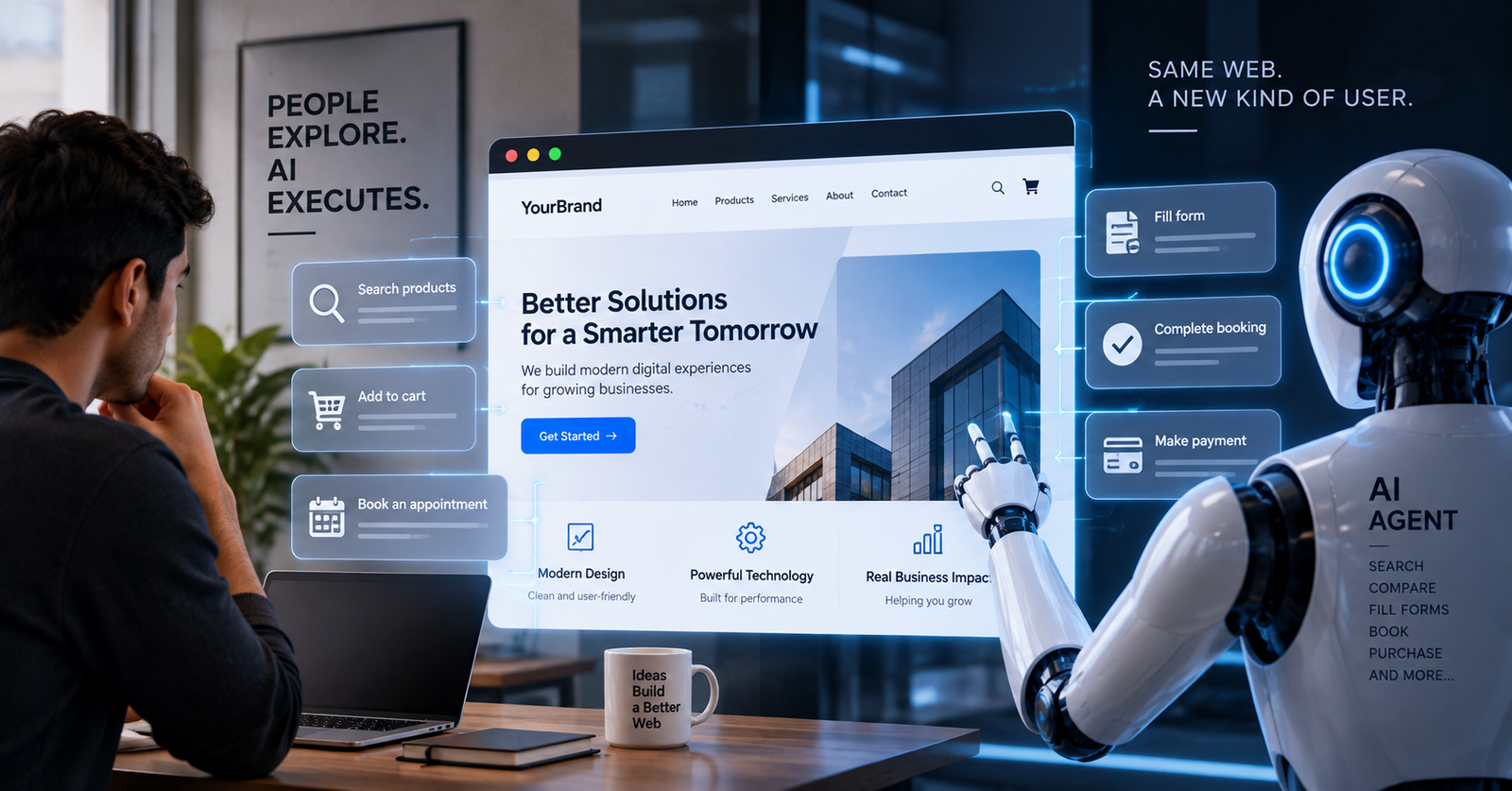
For decades, websites have been designed around one basic assumption: a human being is sitting in front of a screen. We open a browser, read information, click buttons, fill out forms, compare products and eventually complete an action. The entire web experience, from navigation menus to checkout pages, has largely been designed around how people see and interact with a website. But that assumption is beginning to change. As AI agents become capable of browsing websites, understanding information and performing tasks on behalf of users, the web may be entering a new phase where websites have another important type of visitor: AI.
This does not mean that humans are disappearing from the web. Instead, AI agents are increasingly becoming an additional layer between people and online services. A user might eventually tell an AI assistant, “Find me a hotel in Mumbai for this weekend under ₹8,000 and compare the options,” rather than manually opening multiple websites, entering dates, applying filters and comparing results. The AI agent can potentially handle some of these steps by interacting with websites and services on the user's behalf. Modern agentic browsers are already being developed around this idea, with AI systems capable of navigating web pages and carrying out multi-step tasks.
This creates an interesting question for web developers: if a website is no longer being used only by humans, should it also be designed to communicate clearly with AI agents? A human can look at a button labelled “Book Now” and immediately understand what it means. An AI agent, however, needs to understand what that button does, what information is required, what conditions apply and whether it has permission to perform the action. This difference may eventually influence how websites are structured, documented and developed.
From Clicking Buttons to Giving Instructions
The traditional web requires users to understand how a website works. If someone wants to purchase a product, they usually search for it, open a product page, select a size, add the product to a cart, enter an address, choose a payment method and complete the purchase. Each step requires human interaction.
AI agents introduce another possibility. Instead of manually completing every step, a user could provide an instruction describing the desired outcome. The agent could then identify relevant information, interact with websites and services, and perform permitted actions. The important change is that the user is expressing an intention rather than manually operating every part of the interface.
This is one reason the development of agentic browsers is attracting attention. These systems are being designed to combine conventional browsing with AI-based reasoning and task execution. However, the technology is still developing, and the ability of agents to reliably complete complicated tasks varies between systems.
What Makes an AI Agent Different From a Search Engine?
A search engine primarily helps users find information. An AI agent can potentially go further by using that information to perform a sequence of actions.
Consider the difference between asking, “Which restaurants are available near me?” and saying, “Find a restaurant for four people tomorrow evening and make a reservation after showing me the options.” The first request mainly requires information retrieval. The second requires understanding an objective, gathering information, interacting with services and potentially taking an action.
This distinction is important for web development because actions require more than readable content. An agent needs to understand what a website offers and how it is allowed to interact with it. It may need to know which actions are available, what information they require, which actions require confirmation and which actions are not permitted.
The web community is beginning to explore these questions through new standards and community initiatives. In 2026, the W3C launched a Web Content Browser for AI Agents Community Group to investigate ways of representing web content in formats that are more efficient and useful for AI agents. The group notes that simply providing raw HTML or DOM snapshots to AI systems can be inefficient and may lose important meaning.
The Rise of Agent-Friendly Websites
For decades, developers have focused on making websites understandable to humans. Semantic HTML, accessibility standards, clear navigation and responsive design all help people understand and interact with web content. The rise of AI agents introduces another consideration: making the meaning and capabilities of a website easier for machines to understand.
Imagine an online shopping website. A human can visually understand that one button adds a product to a shopping cart while another proceeds to checkout. An AI agent needs a reliable way to distinguish those actions and understand their consequences.
This is where structured interfaces become important. Rather than forcing an AI agent to interpret every element of a visual interface, websites can potentially expose clearly defined capabilities that an agent can understand and use. The goal is not necessarily to replace the existing interface, but to provide a more reliable machine-readable layer alongside it.
What Is WebMCP?
One of the most notable developments in this area is WebMCP, a proposed open web standard announced by Google in 2026. WebMCP is designed to allow developers to expose structured tools, including JavaScript functions and HTML forms, so browser-based AI agents can interact with websites more reliably and efficiently. Google announced an experimental WebMCP origin trial beginning with Chrome 149.
The basic idea is relatively simple. Instead of an AI agent having to figure out everything from the visual page, a website could explicitly describe certain actions that an agent can perform. For example, an appointment website might expose capabilities related to checking availability or selecting an appointment. A shopping website might expose functions related to searching products or managing a cart.
This could reduce the amount of guesswork required from an AI system. However, WebMCP is still a proposed technology and part of an emerging ecosystem, so it should not be treated as a finalized replacement for existing web-development practices.
The Web May Need More Than One Interface
This development raises an interesting possibility for the future of web development. A website may increasingly need to serve two different types of users: humans and AI agents.
The human interface will continue to focus on visual design, accessibility, navigation and usability. The machine-facing layer may focus more heavily on structured information, clearly defined capabilities, permissions and predictable interactions.
This does not necessarily mean developers will create two completely separate websites. Instead, the same underlying web application could expose information and actions in ways that are useful to both humans and machines.
The idea is already being explored beyond WebMCP. W3C community groups created in 2026 are examining how AI agents can discover web resources, understand their purpose and determine what actions they are permitted to perform. One newer initiative, the Introduction Layer Community Group, is specifically exploring how web resources could communicate their identity, purpose, constraints and responsible party to AI agents.
What Does This Mean for Web Developers?
For developers, the rise of AI agents does not mean that fundamental web-development skills suddenly become irrelevant. HTML, CSS, JavaScript, APIs, databases, authentication, accessibility, performance and security remain essential.
What may change is how developers think about the interface between a website and the systems interacting with it. Developers may increasingly need to consider whether important information is structured clearly, whether actions are predictable, whether APIs are well designed and whether an AI system can understand the difference between reading information and performing an action.
Good web development has always involved making systems understandable and predictable. The difference is that the user consuming that system may no longer always be a person.
Security Becomes Even More Important
Giving AI agents the ability to interact with websites also introduces serious security questions. An AI that can read information is one thing. An AI that can click buttons, submit forms, make purchases or access accounts has much greater potential impact.
One major concern is prompt injection. A malicious webpage could contain instructions designed to manipulate an AI agent into performing an unintended action. Researchers at the University of Washington studied seven agentic browsers in early 2026 and found significant security concerns in several systems. Their research demonstrated that, under certain conditions involving successful prompt injection, an agent could potentially bypass protections such as the browser's same-origin policy and access information or perform actions across websites.
This highlights an important difference between traditional web automation and AI-powered agents. A traditional program generally follows instructions that developers explicitly define. An AI agent interprets instructions and context, which creates additional opportunities for unexpected behaviour.
As a result, future agent-friendly websites will need more than convenient machine-readable interfaces. They will also need strong authentication, authorization, confirmation mechanisms, isolation and safeguards around sensitive actions.
Who Controls What an AI Agent Can Do?
Another important question is permission. If an AI agent is browsing a website on behalf of a user, should it automatically be allowed to perform every action available to the user?
Probably not every action should be treated equally. Reading a public product description is very different from deleting an account or making a financial transaction. A useful agent ecosystem therefore needs ways for websites to communicate what an agent can do, what it cannot do and when a human must confirm an action.
The emerging standards work around AI agents reflects this challenge. The W3C's Agent-to-Web Framework community group, for example, is exploring machine-readable mechanisms through which website operators can communicate governance policies for AI agents, including questions around actions, authentication and human verification.
Are We Moving Toward an Agentic Web?
The phrase “agentic web” describes a possible future in which AI agents do more than simply read online information. They could discover services, communicate with websites, use tools and perform actions across different platforms.
There are already standards and community projects exploring different parts of this problem. W3C currently lists initiatives covering AI agent protocols, web content designed for AI agents, agent-to-web interaction and mechanisms for introducing web resources to AI systems.
At the same time, these technologies are still evolving. There is no single universally adopted standard that has transformed the entire web into an agent-first environment. Developers and standards organizations are still working through questions around interoperability, security, permissions, identity and user control.
The Future of Web Development May Be About More Than Screens
The biggest change may not be that websites become completely different. Instead, the way we think about a website may expand.
A website has traditionally been considered a digital interface through which humans access information and services. In an increasingly AI-driven environment, it could become a structured service that can communicate with people, applications and AI agents.
The next generation of web developers may therefore have to think beyond questions such as “Does this page look good?” and “Does this button work?” They may also need to ask whether the website clearly communicates its information, capabilities, permissions and limitations to software acting on behalf of a user.
The web was originally built around documents, links and human interaction. Today it has evolved into a platform for applications, commerce, communication and services. AI agents represent another potential step in that evolution. Whether the future becomes fully agent-driven or develops into a hybrid model where humans and AI work together remains to be seen. What is becoming clear, however, is that the web is no longer being designed only for people who sit behind a screen and click buttons. It is increasingly being designed with a new kind of user in mind: software that can understand, navigate and interact with the web on our behalf.