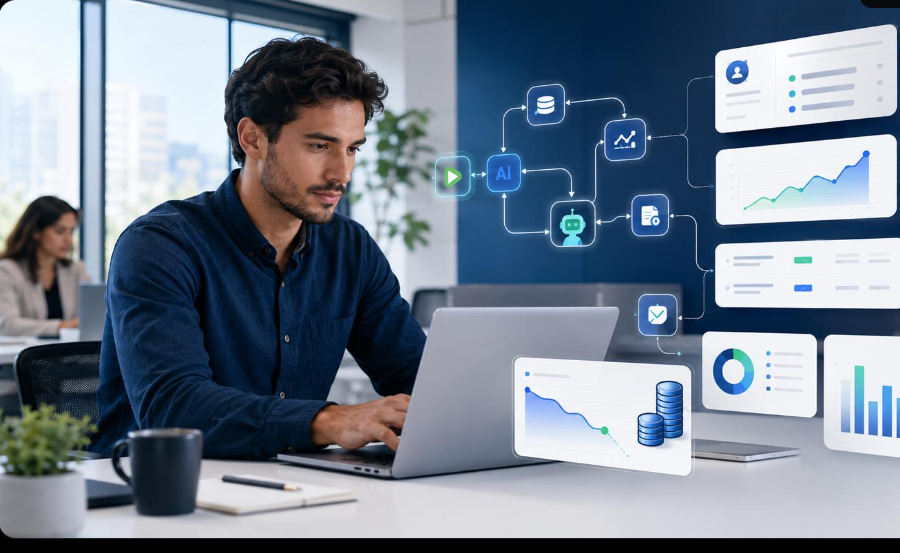
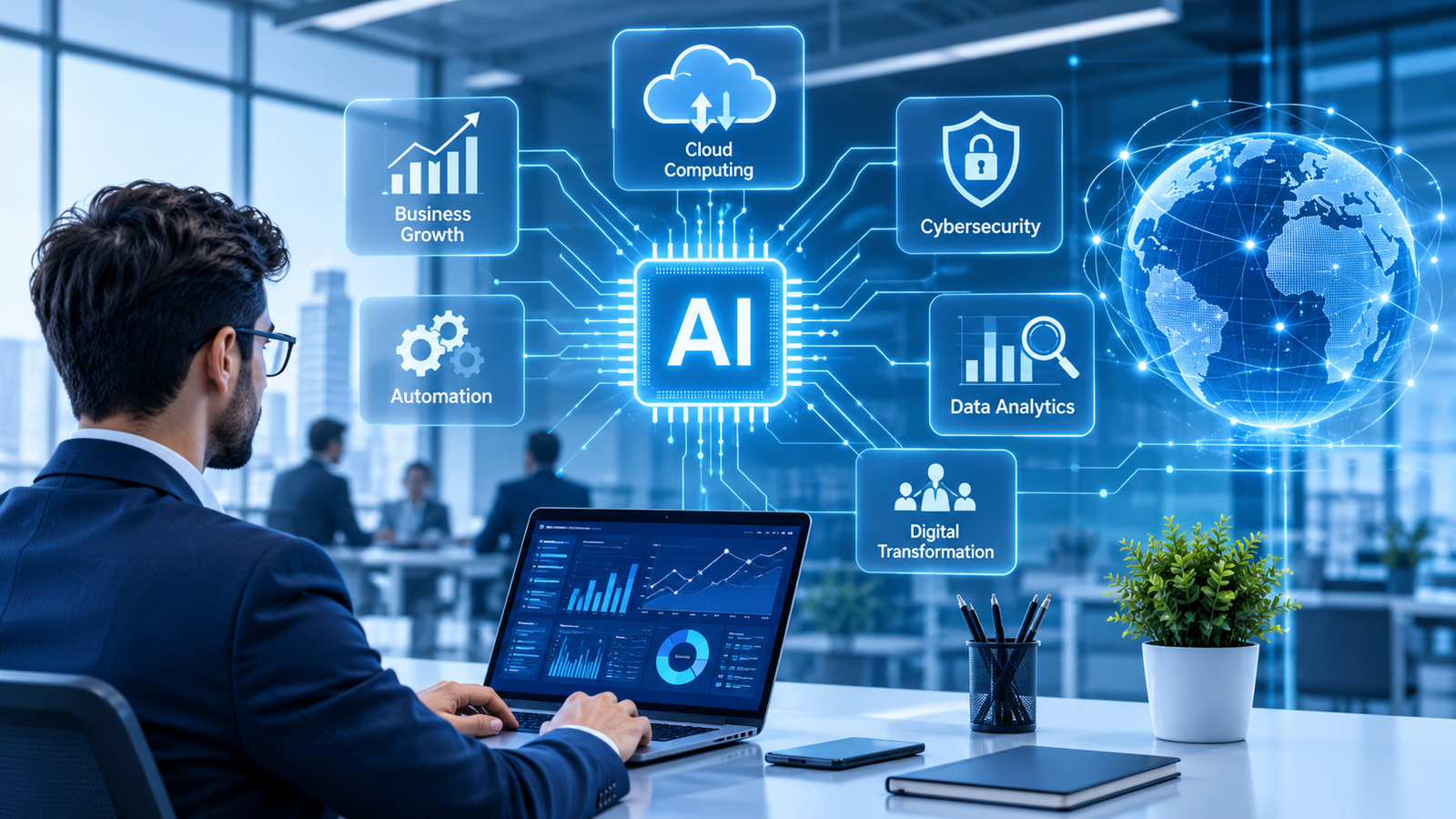
The future of business technology is entering an important phase as companies increasingly depend on digital solutions to improve operations, reduce costs, and deliver better customer experiences. Technology is no longer simply a support function for businesses. It has become a major driver of growth, innovation, and competitive advantage.
As businesses prepare for 2027, several technologies are expected to influence how organisations operate. Artificial intelligence, intelligent automation, cloud computing, cybersecurity, and advanced data analytics are changing traditional business models and creating new opportunities across industries.
From small businesses adopting automated customer management systems to large enterprises implementing AI-powered decision-making tools, digital transformation is becoming essential for long-term success.
But what exactly will change in 2027? And how should businesses prepare for the next stage of technological development?
Let's explore the major business technology trends expected to shape the year ahead.
1. Artificial Intelligence Will Become a Core Business Tool
Artificial intelligence (AI) is expected to become even more integrated into everyday business operations in 2027. While many organisations currently use AI for content creation, customer support, research, and data analysis, its role is expanding towards more complex business activities.
Companies are increasingly exploring AI systems that can analyse information, recommend actions, manage repetitive tasks, and support decision-making.
For example, businesses may use AI to:
-
Analyse customer behaviour and purchasing patterns.
-
Identify potential sales opportunities.
-
Generate business reports automatically.
-
Predict customer requirements.
-
Improve marketing campaign performance.
-
Support recruitment and employee management.
One important development will be the growing adoption of AI agents. Unlike traditional AI tools that mainly respond to individual instructions, AI agents can perform multiple connected tasks within defined workflows.
For example, an AI-powered sales agent could identify potential customers, organise lead information, prepare follow-up messages, and update a CRM system with appropriate human oversight.
This could help businesses improve efficiency while allowing employees to focus on more strategic responsibilities.
2. Business Automation Will Reduce Repetitive Work
Business automation will become an increasingly important part of organisational growth in 2027. Companies are looking beyond basic automated emails and scheduled notifications towards connected workflows that manage multiple business processes.
Automation can reduce manual work, minimise operational errors, and improve consistency across departments.
Some important areas where automation will create value include:
Sales and Marketing: Automated lead generation, email campaigns, customer segmentation, and follow-up reminders can help sales teams manage prospects more effectively.
Human Resources: Recruitment screening, interview scheduling, employee onboarding, and attendance management can become more efficient through automation.
Finance and Accounting: Invoice processing, expense tracking, payment reminders, and financial reporting can reduce administrative workloads.
Customer Support: Automated chatbots and intelligent support systems can respond to common customer queries and direct complex requests to human representatives.
In 2027, businesses that connect automation across departments rather than using isolated tools may gain greater operational benefits.
3. Cloud Computing Will Support Flexible Business Operations
Cloud computing will continue to play a major role in the future of business technology. As organisations adopt remote and hybrid working arrangements, cloud-based platforms provide employees with access to business applications and information from different locations.
Cloud technology also allows companies to scale their infrastructure according to changing business requirements.
Instead of investing heavily in physical servers and IT infrastructure, businesses can use cloud services to manage applications, databases, storage, and computing resources.
Key developments to watch include:
-
Greater adoption of hybrid and multi-cloud environments.
-
Improved cloud security and access management.
-
Cloud-based collaboration platforms.
-
Scalable business applications.
-
Integration between cloud platforms and AI systems.
For startups and small businesses, cloud computing can reduce infrastructure costs and provide access to technology that was previously difficult to implement.
However, organisations must also focus on data protection, regulatory compliance, and cloud infrastructure management.
4. Cybersecurity Will Become a Business Priority
As businesses become more digitally connected, cybersecurity risks will continue to grow. Cyberattacks, phishing, ransomware, identity theft, and data breaches can affect organisations regardless of their size.
In 2027, cybersecurity will increasingly become a leadership-level responsibility rather than a concern limited to IT departments.
Businesses will need to strengthen their digital security strategies to protect customer information, financial records, employee data, and internal systems.
Some important cybersecurity practices include:
-
Implementing multi-factor authentication.
-
Using advanced identity and access management systems.
-
Conducting regular security assessments.
-
Training employees to identify phishing attacks.
-
Maintaining secure data backups.
-
Monitoring networks for suspicious activities.
AI will also play an important role in cybersecurity by helping organisations identify unusual behaviour and detect potential threats more quickly.
At the same time, cybercriminals may use AI to create more convincing phishing campaigns and sophisticated attacks. This makes continuous security improvement essential.
5. Data Analytics Will Improve Business Decision-Making
Business decisions are becoming increasingly dependent on accurate and timely information. In 2027, advanced data analytics will help companies understand their operations, customers, competitors, and market opportunities.
Instead of relying entirely on historical reports and manual analysis, organisations will increasingly use real-time dashboards and predictive analytics.
For example, a retail company can analyse purchasing patterns to identify popular products and forecast future demand. A marketing team can evaluate campaign performance to understand which channels generate the highest number of qualified leads.
Predictive analytics can also help organisations:
-
Forecast sales and revenue.
-
Identify customer retention risks.
-
Understand changing market demand.
-
Improve inventory management.
-
Evaluate employee performance.
-
Identify operational inefficiencies.
Businesses that develop strong data management practices will be better positioned to turn information into practical decisions.
6. Customer Experience Will Become More Personalised
Customer expectations are changing as digital services become faster and more convenient. In 2027, businesses will increasingly use technology to deliver personalised experiences across websites, mobile applications, email campaigns, and customer support channels.
AI-powered recommendation systems and customer relationship management (CRM) platforms can help companies understand customer preferences and provide more relevant interactions.
For example, an e-commerce business can recommend products based on browsing behaviour and previous purchases. A service provider can use CRM information to send personalised updates and follow-up messages.
Businesses will also focus on creating connected customer experiences across multiple communication channels.
The objective is not simply to automate customer interactions but to make them more relevant, convenient, and consistent.
Companies that combine intelligent technology with human support can build stronger customer relationships and improve customer loyalty.
7. Low-Code and No-Code Platforms Will Expand
Developing business software traditionally required specialised programming knowledge, technical resources, and significant investment.
Low-code and no-code platforms are changing this approach by allowing organisations to create applications, automate workflows, and develop internal business tools with limited coding requirements.
In 2027, these platforms are expected to remain important for businesses looking to accelerate digital transformation.
Companies can use them to build:
-
Internal employee management applications.
-
Customer relationship management tools.
-
Workflow automation systems.
-
Inventory management applications.
-
Reporting dashboards.
-
Customer service portals.
These platforms can help smaller organisations develop digital capabilities without maintaining large software development teams.
However, businesses must still consider application security, scalability, integration, and data governance before adopting these solutions.
8. The Internet of Things Will Connect More Business Operations
The Internet of Things (IoT) refers to physical devices connected to the internet that collect and exchange information.
IoT technology is already being used in manufacturing, logistics, healthcare, agriculture, retail, and smart infrastructure.
Its business applications are expected to expand further in 2027 as organisations look for better ways to monitor equipment, track assets, and improve operational performance.
For example, manufacturing companies can use connected sensors to monitor machinery and identify maintenance requirements before equipment failures occur.
Logistics businesses can track shipments and monitor storage conditions, while retailers can use connected devices to manage inventory more efficiently.
The combination of IoT, cloud computing, and AI can help organisations create more connected and intelligent operational environments.
9. Digital Payments and Financial Technology Will Continue to Evolve
Financial technology is changing how businesses accept payments, manage transactions, and handle financial operations.
Digital payment systems, payment gateways, financial automation, and integrated accounting platforms are helping organisations simplify financial management.
In India, the continued adoption of UPI and digital payment infrastructure demonstrates how technology can make transactions more accessible and convenient for businesses and consumers.
In 2027, businesses will increasingly focus on:
-
Faster digital payment processing.
-
Automated billing and invoicing.
-
Integrated financial management systems.
-
Improved fraud detection.
-
Digital transaction tracking.
-
Secure payment experiences.
These developments can help businesses reduce administrative work and provide customers with more convenient payment options.
10. Technology Skills Will Become Essential for the Workforce
The future of business technology will not depend on software and infrastructure alone. Employees will also need to develop new skills to work effectively with emerging digital tools.
As AI and automation become more common, organisations will increasingly value employees who understand how to use technology, interpret data, solve problems, and adapt to changing workflows.
Some important skills for the coming years include:
-
AI literacy and prompt engineering.
-
Data analysis and interpretation.
-
Digital communication.
-
Cybersecurity awareness.
-
Business process automation.
-
Technology-based problem-solving.
Companies will need to invest in employee training and continuous learning to ensure that their workforce can adapt to technological changes.
Rather than replacing every traditional job function, technology will also change how many roles are performed and what skills they require.
How Businesses Can Prepare for Technology Changes in 2027
Understanding emerging technologies is only the first step. Businesses must also develop a practical strategy to implement them effectively.
Here are some important steps organisations can consider:
1. Evaluate Existing Business Processes
Identify repetitive activities, operational challenges, and areas where technology can improve productivity.
2. Invest in Scalable Digital Solutions
Choose software and technology platforms that can grow alongside the organisation.
3. Adopt AI Strategically
Start with practical applications such as customer support, reporting, marketing automation, and data analysis.
4. Strengthen Cybersecurity
Develop security policies, protect sensitive information, and regularly review access permissions.
5. Improve Data Management
Maintain accurate business information and use analytics tools to support better decisions.
6. Train Employees
Provide employees with opportunities to understand new technologies and develop relevant digital skills.
7. Measure Technology Performance
Evaluate whether technology investments are improving productivity, reducing costs, increasing revenue, or enhancing customer satisfaction.
Businesses should avoid adopting new technology simply because it is trending. Every investment should address a genuine business requirement.
Challenges Businesses May Face in 2027
Although emerging technologies offer significant opportunities, their adoption also presents challenges.
Some organisations may struggle with the cost of implementation, employee resistance, integration with existing systems, and a lack of technical expertise.
Data privacy and cybersecurity will also remain important concerns, particularly as companies depend on interconnected digital platforms.
Another challenge will be choosing the right technology from an increasingly crowded market. Not every AI tool, automation platform, or software solution will deliver measurable business value.
To overcome these challenges, organisations should focus on gradual implementation, employee training, reliable technology partners, and clear performance indicators.
Conclusion
The future of business technology in 2027 will be shaped by intelligent systems, automation, connected platforms, and data-driven operations. Artificial intelligence, cloud computing, cybersecurity, analytics, and digital payments will influence how companies manage their resources and interact with customers.
However, technology alone will not guarantee business success. Organisations must understand their requirements, invest in suitable solutions, and prepare their employees for changing digital environments.
Businesses that combine technological innovation with effective leadership, strategic planning, and customer-focused operations will be better positioned to adapt to future challenges.
As 2027 approaches, the most successful organisations will not necessarily be those using the most technology, but those using the right technology to solve real business problems.
Frequently Asked Questions (FAQs)
1. What are the major business technology trends in 2027?
Major business technology trends in 2027 include artificial intelligence, AI agents, business automation, cloud computing, cybersecurity, predictive analytics, IoT, and low-code development platforms.
2. How will AI change businesses in 2027?
AI will help businesses automate repetitive tasks, analyse large datasets, improve customer experiences, support decision-making, and optimise business operations.
3. Why is business automation important in 2027?
Business automation helps organisations reduce manual workloads, improve operational efficiency, minimise errors, and manage repetitive processes more effectively.
4. Will small businesses benefit from emerging technologies?
Yes. Small businesses can use affordable cloud platforms, AI tools, CRM software, and automation solutions to improve productivity, manage customers, and compete more effectively.
5. How can companies prepare for technological changes in 2027?
Companies can prepare by evaluating existing processes, adopting scalable technology, strengthening cybersecurity, training employees, and investing in solutions that address actual business needs.