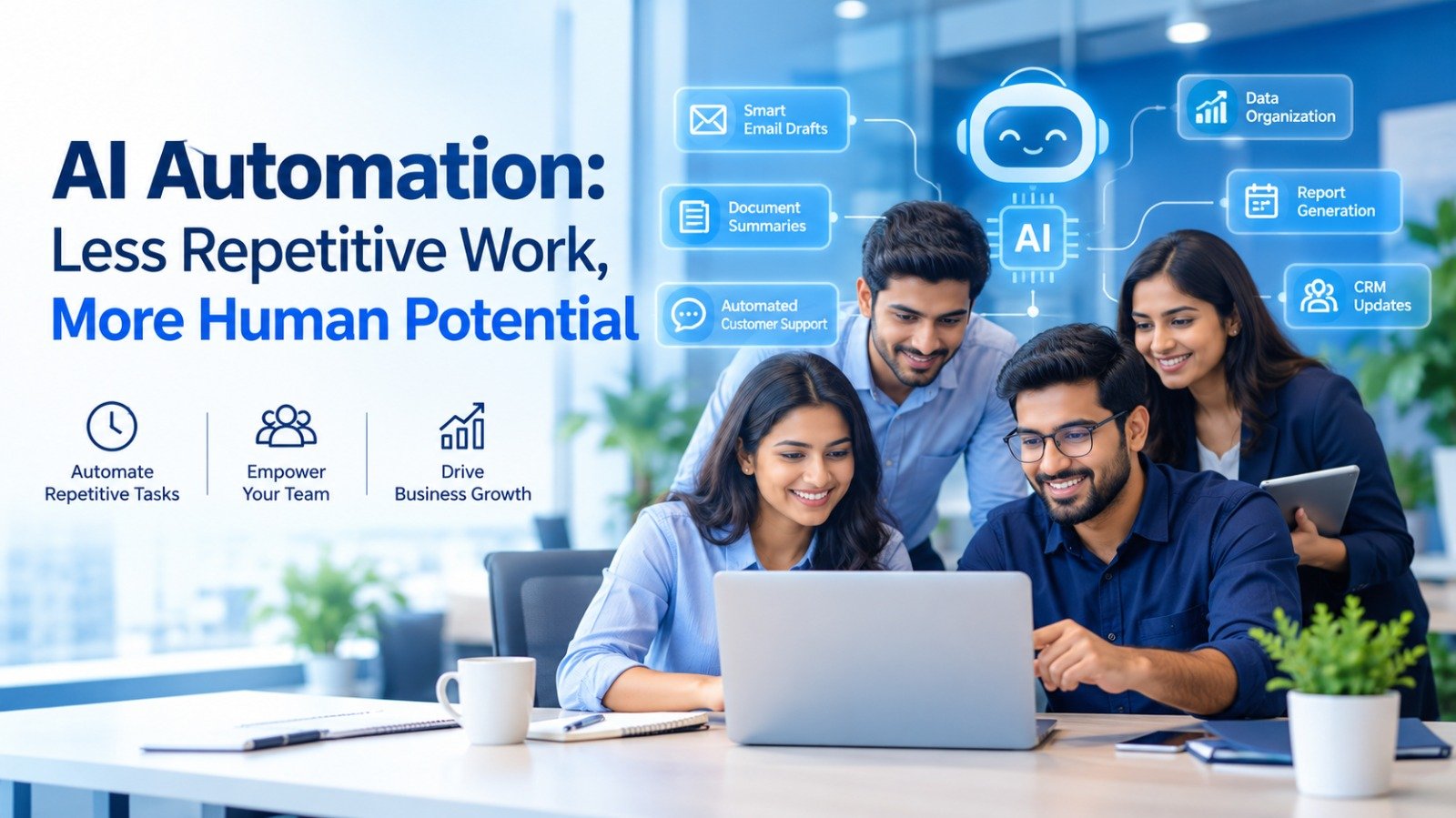
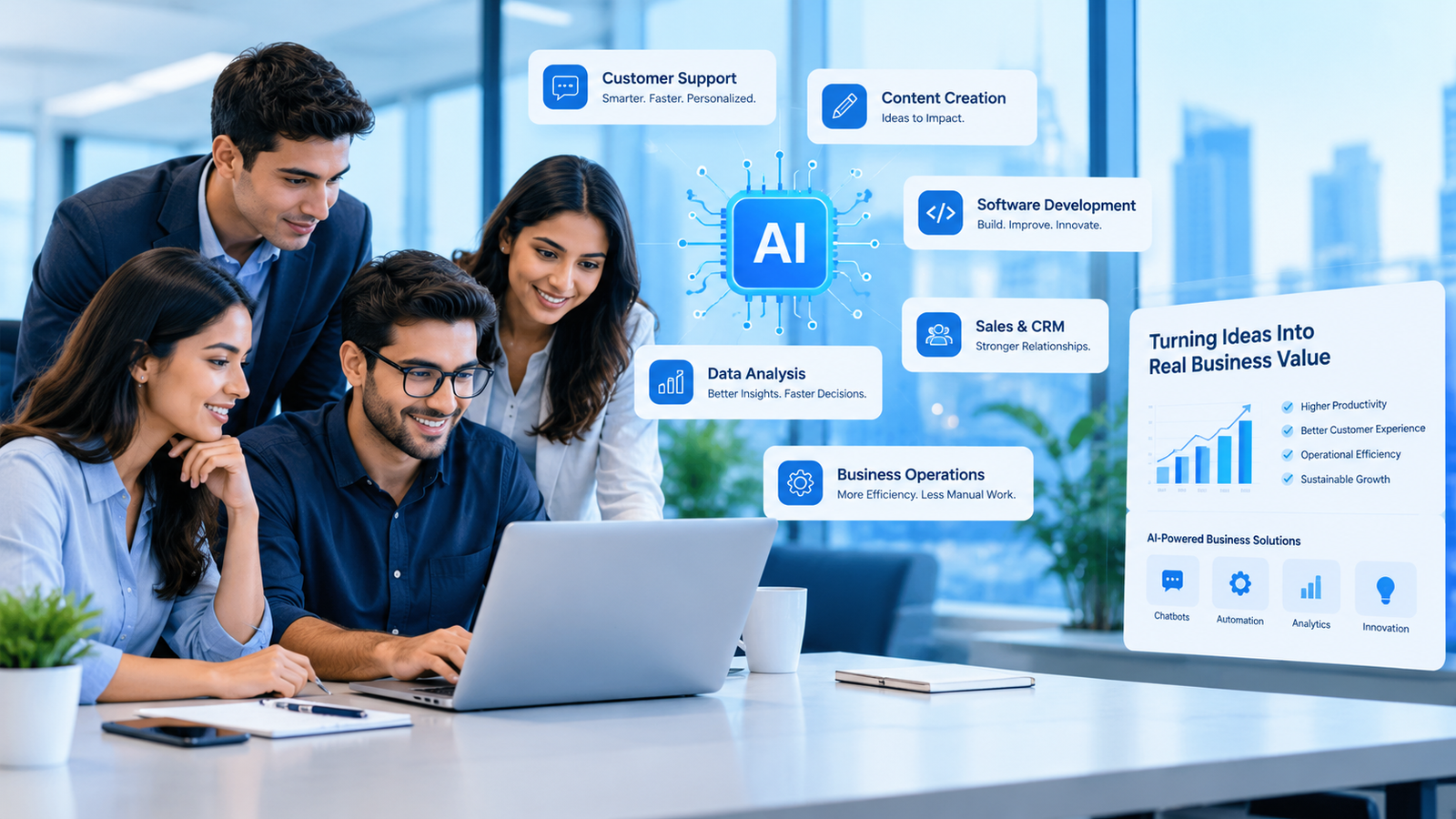
Generative AI in business is moving beyond experimentation and becoming a practical tool for improving productivity, customer experience, and operational efficiency. Companies that once tested AI through pilot projects are now exploring how to integrate it into everyday workflows, from customer support and marketing to software development and data analysis.
The shift is important because businesses are no longer evaluating artificial intelligence only for its novelty. They want measurable results, including reduced manual work, faster decision-making, improved service quality, and better use of company resources.
As generative AI technology continues to evolve, organizations are focusing on practical applications that solve specific business problems rather than adopting AI simply to follow a technology trend.
What Is Generative AI in Business?
Generative AI in business refers to the use of artificial intelligence systems that can create new content, summarize information, generate code, answer questions, and assist with complex tasks based on user instructions and available data.
Unlike traditional automation, which generally follows predefined rules, generative AI can work with natural language and generate context-sensitive responses. Depending on the system, it can support employees in drafting documents, analyzing information, assisting customers, and developing software.
Businesses commonly use generative AI through:
-
AI-powered chatbots and virtual assistants
-
Content creation and marketing tools
-
Document summarization and information retrieval
-
Coding assistants and software development tools
-
Enterprise knowledge assistants
-
AI systems integrated with customer relationship management (CRM) platforms
The real value comes when these capabilities are integrated into existing business processes with appropriate security, human oversight, and performance measurement.
Why Companies Are Moving Beyond AI Experiments
Early generative AI adoption often involved employees experimenting with public AI tools or running small proof-of-concept projects. While these experiments helped organizations understand the technology, many companies are now looking for solutions that can operate reliably within their business environments.
Several factors are driving this transition.
1. Pressure to Improve Productivity
Businesses are constantly looking for ways to complete repetitive tasks faster without compromising quality. Generative AI can help employees prepare reports, summarize lengthy documents, draft communications, and find relevant information more efficiently.
Instead of replacing every existing process, companies can introduce AI assistance into selected steps of a workflow.
2. Growing Demand for Better Customer Experiences
Customers expect quick, relevant, and consistent responses across digital channels. AI-powered assistants can help businesses answer common questions, guide users through processes, and support service teams with relevant information.
Human employees can then focus on complex cases that require judgment, empathy, or specialized knowledge.
3. Better Integration With Business Software
Generative AI is increasingly being incorporated into productivity platforms, CRM systems, customer support software, and development environments.
This makes it easier for employees to access AI capabilities within tools they already use rather than switching between separate applications.
4. Greater Focus on Measurable Business Outcomes
Organizations are becoming more selective about AI investments. Instead of measuring success by the number of AI tools introduced, they are assessing whether these tools reduce processing time, improve accuracy, increase customer satisfaction, or contribute to revenue growth.
This shift from experimentation to measurable outcomes is central to sustainable AI adoption.
Real-World Use Cases of Generative AI in Business
Generative AI has applications across multiple departments. The most effective use cases are usually those that address frequent, time-consuming tasks with clear performance indicators.
1. Customer Service and Support Automation
Customer service is one of the most visible applications of generative AI. AI-powered assistants can respond to frequently asked questions, summarize customer conversations, suggest replies, and help support agents locate relevant information.
For example, an online retailer can use an AI assistant to answer questions about shipping policies, product specifications, and return procedures. More complicated complaints can be transferred to a human representative.
Businesses should establish clear escalation rules and verify that AI-generated responses are accurate, particularly when dealing with refunds, financial matters, or sensitive customer information.
2. Marketing and Content Creation
Marketing teams can use generative AI to accelerate content production and campaign planning. It can assist with creating first drafts of blog posts, social media captions, email campaigns, product descriptions, and advertising variations.
For example, a small business launching a new product can use AI to develop initial messaging for different customer segments. Its marketing team can then refine the content to reflect the brand's voice, verify factual claims, and ensure consistency.
AI-generated content should not automatically be published without review. Original insights, reliable information, brand differentiation, and editorial quality remain essential.
3. Software Development and IT Operations
Software teams are adopting AI coding assistants to generate code suggestions, explain unfamiliar code, create test cases, and assist with debugging.
These tools can help developers reduce repetitive work and spend more time on system architecture, problem-solving, and product improvements.
However, AI-generated code may contain errors, security vulnerabilities, or inefficient approaches. Developers must review, test, and validate the output before using it in production systems.
4. Sales and CRM Automation
Generative AI can help sales teams prepare personalized communications, summarize sales calls, draft follow-up messages, and retrieve information about customer accounts.
When integrated with a customer relationship management (CRM) system, AI can also help employees interpret customer records and prepare for sales conversations.
For example, a sales representative could use an AI assistant to summarize previous interactions with a lead and draft a follow-up based on the prospect's interests. The representative can review the message before sending it.
These capabilities can improve consistency in follow-ups and help sales teams spend more time building customer relationships.
5. Internal Knowledge Management
Large organizations often store important information across documents, presentations, policies, support tickets, and internal databases. Finding the right information can consume valuable employee time.
Generative AI assistants can help employees search approved company knowledge sources, summarize documents, and identify relevant internal guidance.
For instance, a new employee may ask an internal assistant about the company's leave policy or onboarding procedure and receive a response based on authorized documents.
Such systems work best when information is current, access permissions are respected, and answers can be traced to reliable source material.
6. Data Analysis and Business Reporting
Generative AI can support business analysts by explaining trends, summarizing reports, generating SQL queries, and helping users explore datasets through natural-language questions.
A sales manager, for example, may want to understand why revenue declined in a particular region. An AI-assisted analytics tool can help identify patterns and suggest areas for further investigation.
However, AI-generated analysis should be checked against the underlying data. Businesses should not treat plausible-sounding explanations as proven causes without additional verification.
7. Human Resources and Employee Support
HR departments can use generative AI to draft job descriptions, prepare onboarding materials, summarize employee feedback, and answer routine policy questions.
An internal HR assistant can help employees locate information about benefits, leave procedures, and workplace policies.
Sensitive HR decisions, including recruitment assessments, promotions, and performance evaluations, require appropriate human judgment, fairness controls, and compliance with applicable employment laws.
How Companies Can Turn AI Pilots Into Practical Solutions
Successful adoption requires more than purchasing a tool or giving employees access to a chatbot. Companies need a clear implementation strategy that connects AI capabilities with business priorities.
Step 1: Identify a Specific Business Problem
Start with a process that consumes significant time, involves repetitive tasks, or creates avoidable delays.
Examples include responding to common support requests, preparing recurring reports, summarizing meetings, and drafting routine communications.
A clearly defined problem makes it easier to determine whether AI is suitable for the task.
Step 2: Establish Baseline Performance
Before implementation, measure how the existing process performs.
Useful metrics may include average task completion time, cost per transaction, response time, error rate, customer satisfaction, and employee workload.
These measurements provide a baseline against which the AI solution can be evaluated.
Step 3: Run a Controlled Pilot
Introduce the AI solution to a limited team or workflow first. Compare its performance with the existing process and collect feedback from employees.
The pilot should test accuracy, usability, reliability, security, and the amount of human intervention required.
A successful demonstration is not enough. The system must perform consistently under realistic working conditions.
Step 4: Connect AI With Existing Workflows
Once the pilot demonstrates value, integrate the solution with relevant business applications and data sources.
Depending on the use case, this may involve CRM software, customer support platforms, document management systems, or analytics tools.
Integration should preserve access controls and avoid exposing confidential information to unauthorized systems.
Step 5: Introduce Human Oversight and Governance
Companies should establish clear rules for when AI can act independently, when employee approval is required, and when a task must be escalated.
High-impact decisions and sensitive activities generally need stronger review procedures than low-risk tasks such as summarizing internal documents.
Employees should also understand the limitations of AI-generated information and know how to report errors.
Step 6: Measure Results and Expand Gradually
After deployment, compare actual performance with the baseline.
If the solution improves productivity or quality without creating unacceptable risks, the company can expand it to additional teams or workflows.
Organizations should continue monitoring results because model performance, business data, and operational requirements can change over time.
Key Benefits of Generative AI for Businesses
When implemented carefully, generative AI can deliver several business benefits.
Improved productivity: Employees can spend less time on repetitive writing, summarization, and information retrieval.
Faster customer service: AI assistants can support quicker responses to routine questions and help service teams handle more requests.
Consistent communication: AI can help teams follow standard messaging and documentation practices.
Better access to information: Employees can find and summarize relevant information without manually reviewing large volumes of documents.
Support for innovation: Teams can use AI to explore ideas, develop prototypes, and test different approaches more quickly.
Operational efficiency: Automating suitable parts of a workflow can reduce delays and improve the use of employee resources.
These benefits are not automatic. Actual results depend on the use case, implementation quality, data access, employee adoption, and ongoing monitoring.
Challenges Businesses Must Address
Despite its potential, generative AI introduces risks that companies must consider before expanding deployment.
Data Privacy and Security
Employees may unintentionally share confidential customer data, internal documents, or proprietary information with AI systems. Businesses need approved tools, clear data-handling policies, and appropriate access controls.
Accuracy and Hallucinations
AI systems can produce incorrect information or unsupported claims. Important outputs should be checked against reliable sources, especially in financial, legal, medical, and other high-impact contexts.
Integration Costs
Connecting AI with existing software may require technical resources, data preparation, workflow redesign, and employee training. Companies should evaluate total implementation and maintenance costs rather than focusing only on subscription prices.
Employee Adoption
Employees may hesitate to use AI because of limited training, uncertainty about expectations, or concerns about job changes. Transparent communication and practical training can help teams understand where AI is useful and where human expertise remains essential.
Governance and Accountability
Businesses need clear ownership for AI-related decisions, monitoring, incident reporting, and compliance. They should define who approves deployments and who is responsible when a system produces an incorrect or harmful result.
How to Measure the ROI of Generative AI
Measuring return on investment helps businesses distinguish meaningful improvements from promising demonstrations.
Companies should evaluate both financial and operational outcomes.
-
Time saved: How much employee time is saved per task?
-
Cost reduction: Has the cost of completing a process decreased?
-
Quality improvement: Are error rates, rework, or inconsistent responses declining?
-
Customer experience: Are response times and customer satisfaction improving?
-
Employee adoption: Are employees using the tool consistently and appropriately?
-
Revenue impact: Is the solution contributing to better lead conversion, customer retention, or sales productivity?
A basic ROI calculation is:
ROI (%) = (Financial benefits − Total costs) ÷ Total costs × 100
Total costs should include software, integration, training, monitoring, and ongoing maintenance. Financial benefits should be based on measurable results rather than assumptions about time saved.
For example, time savings should only be counted as a financial benefit when they translate into productive capacity, reduced expenditure, or another clearly defined business outcome.
The Future of Generative AI in Business
The next phase of generative AI adoption is likely to involve deeper integration into everyday business software, more context-aware assistants, and AI systems capable of completing multiple steps within defined workflows.
Businesses may increasingly use AI to coordinate routine activities across sales, support, marketing, finance, and operations. These systems will still require appropriate permissions, monitoring, and human approval for consequential actions.
The competitive advantage will not necessarily belong to companies using the largest number of AI tools. It will increasingly depend on how effectively organizations combine AI capabilities with reliable data, strong processes, employee expertise, and responsible governance.
Companies that focus on practical problems and measurable outcomes will be better positioned to turn experimentation into sustainable business value.
Conclusion
Generative AI in business is entering a more practical stage of adoption. Companies are moving beyond basic experiments and exploring applications in customer support, marketing, software development, CRM, data analysis, and internal knowledge management.
However, successful implementation requires more than technology. Businesses need clear objectives, reliable data, employee training, security controls, and measurable performance indicators.
By starting with focused use cases and expanding only when results justify further investment, organizations can make generative AI a useful part of their operations while managing its limitations and risks.
The key takeaway: Businesses should not adopt generative AI simply because it is available. They should use it where it solves a real problem, improves a measurable outcome, and supports better work.