Building a website used to require a team of developers, designers, copywriters and marketers working together for weeks or even months. Today, artificial intelligence can generate layouts, write website copy, create images, suggest designs and even produce working code in a fraction of that time. This has changed the way businesses think about website development. A company can now move from an idea to a functional website much faster than before. But there is an important question businesses need to ask: if AI can build the website, can it also decide what the website should achieve?
The answer is not as simple as yes or no. AI is extremely useful when it comes to execution, but a successful website requires much more than execution. A website is not valuable simply because it looks modern or loads quickly. It needs to communicate the right message, reach the right audience, solve a specific problem and guide visitors toward a meaningful action. These decisions are part of digital strategy, and they require an understanding of the business, its customers and its goals.
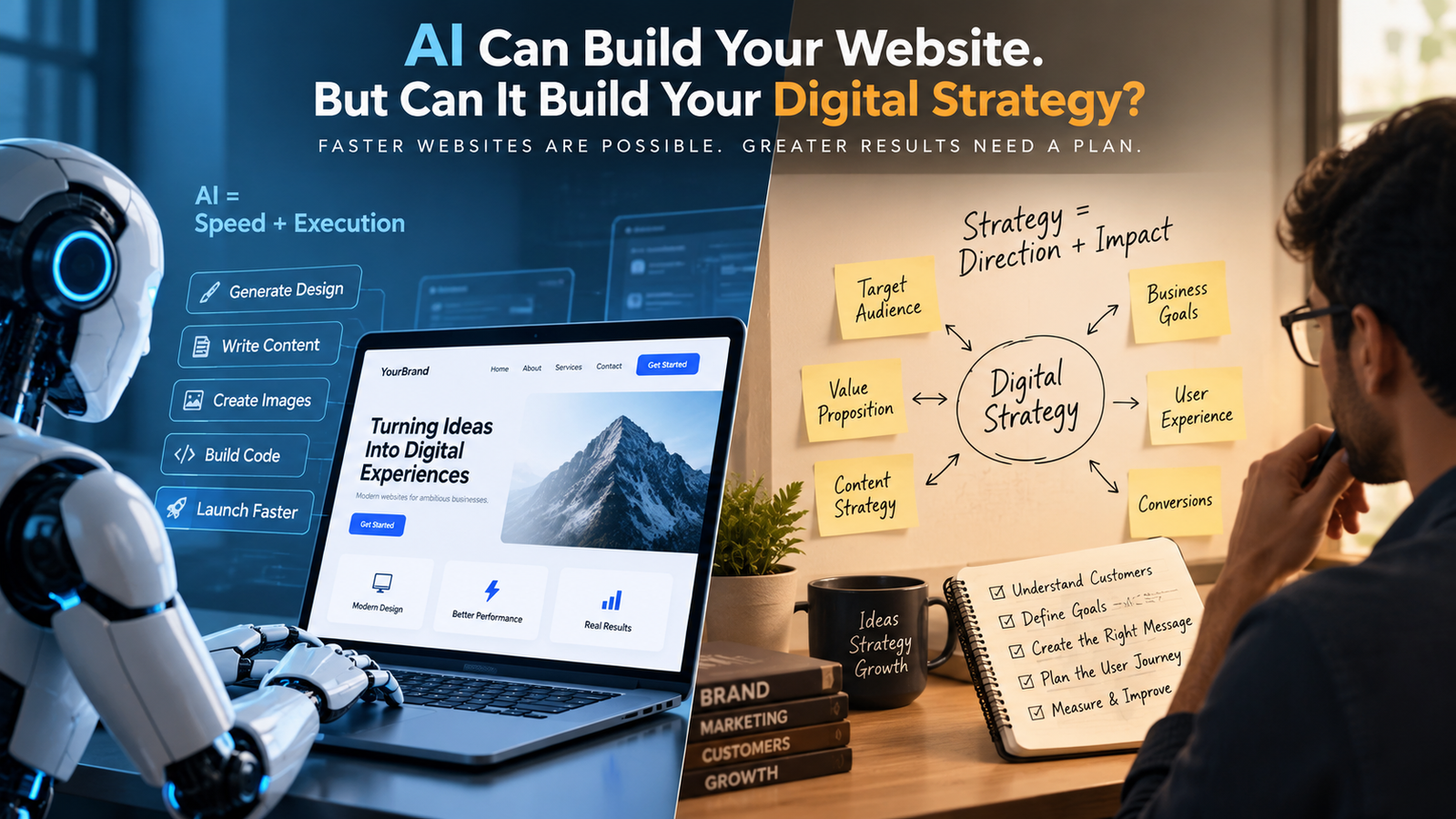
AI can help create the structure of a website in minutes. A business owner can describe the type of website they want and receive suggestions for pages, layouts, headlines, images and calls to action. AI can also help developers generate code, identify errors and speed up repetitive development tasks. For businesses with limited budgets or small teams, this can make website development more accessible. Instead of spending most of their time creating everything from scratch, teams can use AI to accelerate the production process and focus more of their time on decisions that require human judgment.
However, speed does not automatically create effectiveness. Imagine a company selling accounting software to small businesses. An AI tool can generate a professional-looking homepage with sections for features, pricing, testimonials and a contact form. Technically, the website may be perfectly functional. But should the headline focus on saving time, reducing accounting costs, simplifying tax preparation or helping business owners understand their finances? That depends on what the customers actually care about. AI can suggest different options, but understanding which message will resonate with a particular audience requires business and customer insight.
This is where digital strategy becomes important. Before building a website, a business needs to understand who it is trying to reach and what it wants visitors to do. Is the goal to generate leads, sell products, build credibility, provide information or encourage people to contact the company? The answer influences everything from the website structure and content to the user journey and calls to action. Without a clear objective, even a beautifully designed AI-generated website can become little more than an online brochure.
Customer understanding is another area where human input remains important. Businesses know their customers through conversations, sales calls, feedback, support requests and real-world experiences. They understand the questions customers repeatedly ask and the concerns that prevent them from making a purchase. AI can analyse this information and identify patterns, but the quality of its recommendations depends heavily on the information and direction it receives. A business that simply asks AI to “create a website for my company” is likely to receive a generic result because the instruction itself is generic.
The difference becomes clearer when we compare two approaches. The first approach is to ask AI to create a website for a digital marketing agency. The result might include familiar phrases such as “grow your business,” “drive results” and “transform your digital presence.” There is nothing necessarily wrong with these phrases, but hundreds of companies can say the same thing. The second approach begins with a strategy: identify the agency's ideal customers, understand their biggest problems, define what makes the agency different and determine what action the website should encourage visitors to take. AI can then help turn that strategy into content, design and code. The second approach is much more likely to produce a website that feels relevant rather than interchangeable.
This is also changing the role of web developers and designers. AI does not necessarily make these roles less important; instead, it changes where their value comes from. Developers can spend less time writing repetitive code and more time thinking about architecture, security, performance and integrations. Designers can use AI to explore multiple concepts quickly while spending more time refining the user experience and visual identity. Marketers can use AI to generate content variations and analyse information while focusing on positioning, messaging and customer behaviour. In each case, AI becomes a tool that increases the team's capabilities rather than replacing the need for expertise.
There is another reason strategy matters more today: people are no longer discovering businesses only through traditional search engines. Customers increasingly encounter information through social platforms, recommendation systems, AI-powered search experiences and other digital channels. This means a website needs to do more than simply rank for keywords. It needs to clearly communicate what a business does, establish credibility and provide useful information that can support customers throughout their decision-making process. A website that was created quickly but lacks a clear identity may struggle to stand out even if its technical implementation is strong.
AI can also help businesses continuously improve their websites after launch. It can analyse customer feedback, identify common questions, suggest content improvements and help teams test different versions of headlines or calls to action. This creates an opportunity for websites to become more dynamic and data-driven. Instead of treating a website as a finished project that is rarely changed, businesses can treat it as an evolving digital product. But once again, the important question is not simply what AI recommends. Businesses still need to decide which recommendations align with their goals, brand and customers.
The strongest approach, therefore, is not AI versus humans. It is AI working with human strategy. AI can reduce the time required to execute an idea, but humans still need to determine whether the idea is worth executing in the first place. AI can generate ten homepage headlines, but someone needs to understand which one communicates the brand's value. AI can create a user journey, but someone needs to understand whether that journey matches the way customers actually make decisions. AI can generate code, but someone still needs to make sure the final product is secure, scalable and useful.
This creates an interesting shift in the economics of digital products. As AI makes development faster and more accessible, the ability to simply build something is becoming less of a competitive advantage. More businesses can create websites, applications and digital experiences than ever before. The harder challenge is creating something that customers remember, trust and actually use. When execution becomes easier, strategy, differentiation and customer understanding become more valuable.
For businesses considering an AI-powered website, the best starting point is therefore not a prompt asking AI to “build a website.” It is a set of strategic questions. Who is the website for? What problem are we solving? What makes our business different? What do we want visitors to do? What information do they need before taking that action? What should make them trust us? Once these questions are answered, AI can become incredibly powerful in turning those decisions into a working digital experience.
The future of website development is unlikely to be completely human or completely AI-generated. It will be a combination of both. AI will continue to make design, development and content creation faster, while human teams will remain responsible for understanding the business, interpreting customer needs and making strategic decisions. The businesses that benefit most from AI will not necessarily be the ones that use the most AI tools. They will be the ones that know what they want those tools to accomplish.
AI can build a website. It can write the code, generate the copy and suggest the design. But a website that genuinely contributes to business growth needs something more: a clear purpose, a strong understanding of its audience and a strategy behind every important decision. In the age of AI-powered development, the question is no longer just how quickly a website can be built. The more important question is whether there is a meaningful strategy behind what is being built.