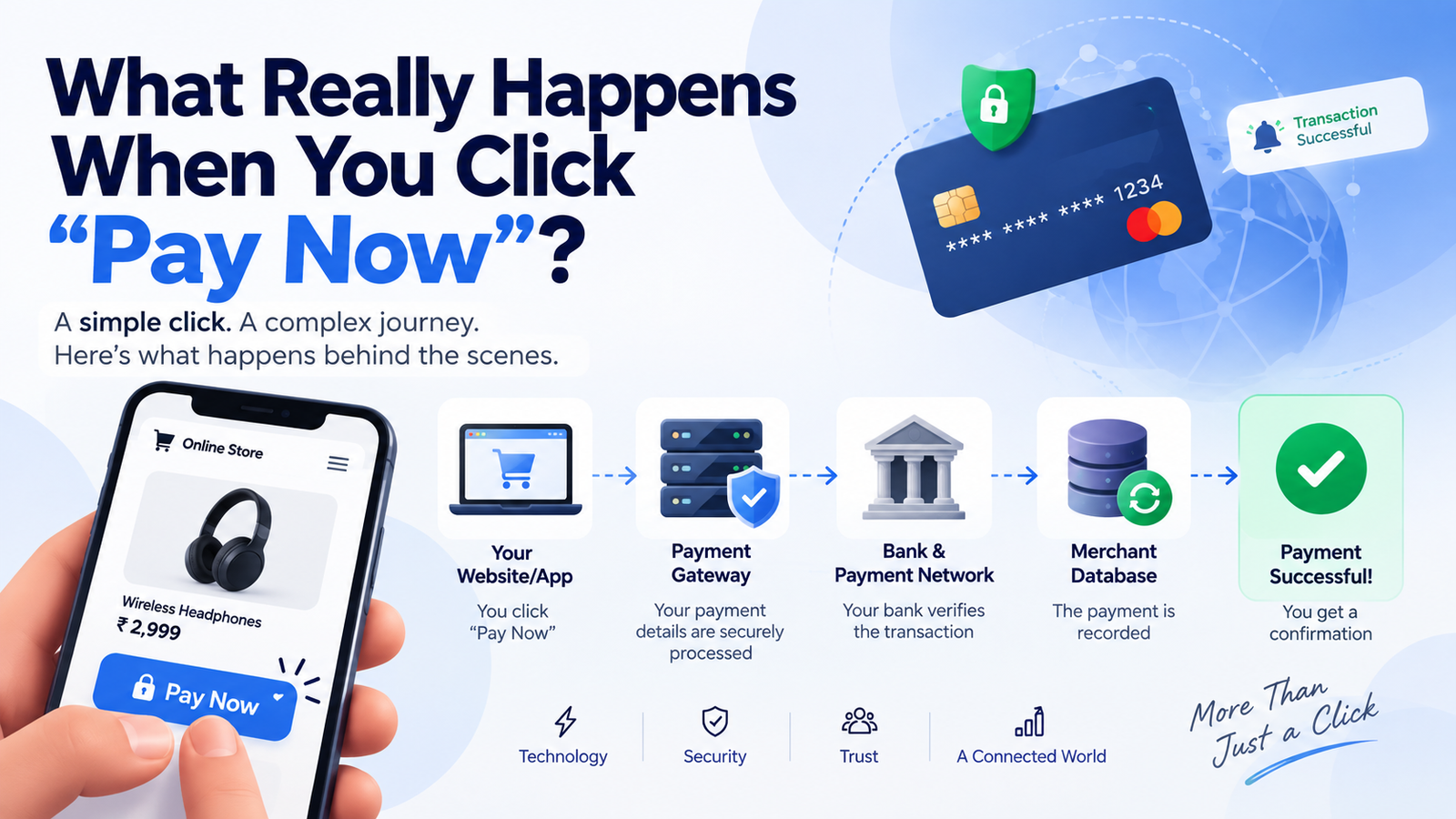
Every online purchase seems incredibly simple. You choose a product, enter your payment details, click “Pay Now,” and within a few seconds, you see a message saying “Payment Successful.” But behind that single click, several systems communicate with each other in a matter of seconds. Your website or app, payment gateway, bank, payment network, authentication systems, and databases all work together to complete the transaction. So, what actually happens after you click that button?
It Starts With a Simple Click
When you click “Pay Now,” the first thing that happens is that the website or application collects the information required to process your payment. Depending on the payment method, this could include card details, UPI information, banking information, or other payment credentials. The application then sends the transaction request to the payment system through a secure connection. At this point, your browser is not simply “sending money.” It is initiating a chain of communication between different systems that need to verify and process the transaction.
Your Payment Request Travels to a Payment Gateway
The next important component is the payment gateway. A payment gateway acts as a bridge between the merchant's website and the financial systems involved in processing the payment. It receives the payment request and securely passes the relevant transaction information to the appropriate payment infrastructure.
For example, imagine that you are purchasing headphones for ₹2,999 from an online store and choose to pay using a debit card. After you click “Pay Now,” the transaction information is securely transferred to the payment gateway. The gateway helps route the request to the appropriate payment network and financial institution so the transaction can be checked and processed.
Security Checks Happen in the Background
Before money moves from one account to another, the transaction needs to go through security and verification checks. These checks are designed to help determine whether the payment request is legitimate and whether it can be processed.
Depending on the payment method and transaction, authentication may involve an OTP, UPI PIN, card verification, or other security mechanisms. Your bank or payment service provider checks the information provided and verifies that the required authentication has been completed. Fraud detection systems may also examine transactions for unusual patterns or suspicious activity.
This entire process can happen so quickly that the user may only notice a short loading screen before receiving the result.
Your Bank Gets Involved
Once the payment request reaches the relevant banking infrastructure, the bank needs to determine whether the transaction can be completed. For a card transaction, this can involve checking the card and transaction details and whether sufficient funds or available credit are present. For a UPI transaction, the payment is authenticated through the UPI system and the linked bank account.
If the necessary checks are successful, the bank authorizes the transaction. If something goes wrong, such as incorrect authentication, insufficient funds, a technical issue, or a transaction being declined, the payment may fail instead.
The important point is that the website selling you the product does not independently decide whether your bank should approve the payment. It receives the result from the payment infrastructure and uses that result to update the transaction.
What Is the Payment Network Doing?
In many payment transactions, a payment network helps move transaction information between the different participants involved in the payment. Card payments, for example, can involve networks that connect merchants, banks, and card issuers.
Think of the payment network as part of the communication infrastructure that helps the transaction reach the appropriate financial institution and return the response. The process may involve several different systems, but the goal is straightforward: securely communicate the transaction request, receive a decision, and return that information to the appropriate parties.
The Database Records the Transaction
Once the transaction is processed, the merchant's systems also need to record what happened. The website's database can store information such as the order ID, transaction status, amount, customer information associated with the order, and payment reference details.
This information is important because the payment is not the end of the process. The merchant still needs to know whether an order should be confirmed, whether the product should be prepared for shipping, and whether the customer should receive a receipt or confirmation.
For example, if you purchase a ₹2,999 pair of headphones, the system may update your order from “Payment Pending” to “Payment Successful.” The website can then proceed with the next stage of fulfilling your order.
What If You See “Payment Failed”?
A failed payment does not necessarily mean that something went wrong with the website itself. There can be many reasons for a failed transaction. Your bank may decline the payment, authentication may fail, your account may not have sufficient funds, a payment service may experience a temporary technical problem, or the transaction may be interrupted before completion.
This is why you may sometimes see a payment fail even though the website itself is working normally. Different systems are involved in the transaction, and an issue with any important part of the process can affect the final result.
In some situations, you may even notice that money appears to have been deducted while the merchant still shows the payment as unsuccessful or pending. This can happen because the systems involved may not update their statuses at exactly the same moment. The transaction may subsequently be reconciled and either completed or reversed according to the payment system's process.
Why Does It Happen So Quickly?
One of the most impressive aspects of modern digital payments is the speed at which these systems communicate. Computers can exchange transaction information in fractions of a second, while automated systems can perform verification and processing without requiring a person to manually approve every ordinary transaction.
This combination of APIs, secure communication, authentication systems, payment infrastructure, banking systems, and databases allows a process that could be extremely complicated behind the scenes to feel almost instant to the customer.
When you click a button, you see one simple action. Behind that action, however, multiple independent systems are coordinating with one another.
Your “Pay Now” Button Is Just the Beginning
The next time you click “Pay Now,” think about what is happening beyond your screen. Your device sends a request, the merchant's system processes it, the payment gateway helps route the transaction, financial systems authenticate and evaluate it, the payment infrastructure communicates the result, and the merchant records the outcome.
What feels like a single click is actually a carefully coordinated digital process involving technology, security, financial infrastructure, and data.
The real achievement of online payments is not that a button can transfer money. It is that many different systems can communicate securely and reliably enough to make that complicated process feel as simple as clicking “Pay Now.”