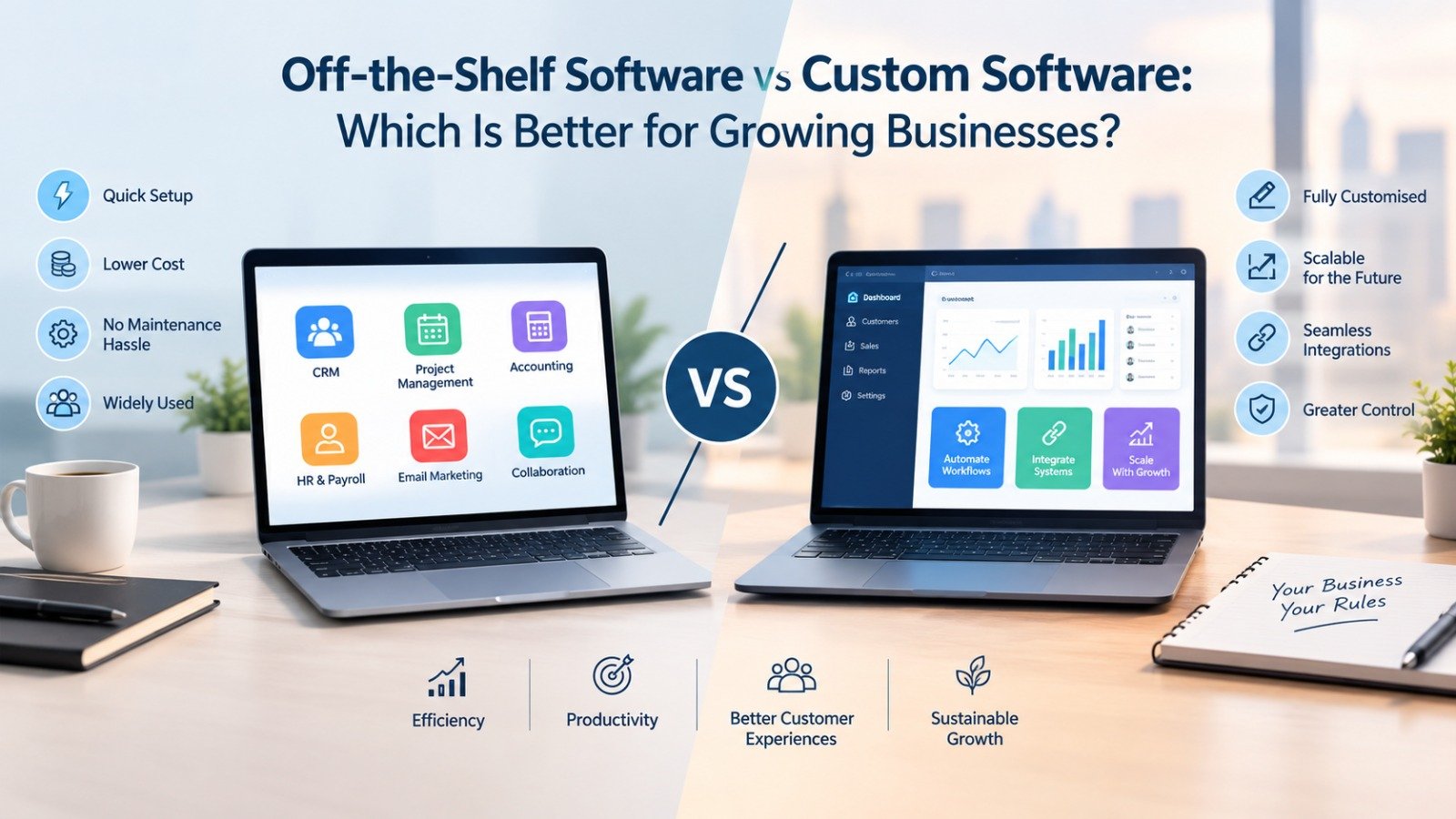

In today's competitive digital landscape, businesses rely on technology to manage operations, serve customers, and achieve sustainable growth. While ready-made software can meet basic business requirements, it may not always support complex workflows, specialized processes, or long-term expansion.
This is where custom software development becomes valuable. It enables businesses to build software tailored to their specific goals, operational needs, and customer expectations.
However, developing custom software requires an investment of time, money, and resources. Therefore, businesses must understand when a tailored solution offers more value than an off-the-shelf product.
In this guide, we explore the key signs that indicate your business may be ready to invest in custom software development and how the right solution can support long-term success.
What Is Custom Software Development?
Custom software development is the process of designing, building, testing, and maintaining software specifically for a business or organization. Unlike ready-made applications created for a broad audience, custom software is developed around particular business requirements.
Examples include customer relationship management (CRM) platforms, inventory management systems, employee management applications, automated reporting tools, booking platforms, and industry-specific business applications.
A well-designed custom solution can integrate with existing systems, automate repetitive tasks, improve data visibility, and adapt as business requirements evolve.
1. Your Business Has Outgrown Off-the-Shelf Software
One of the clearest signs that you should consider custom software development is when your existing tools can no longer support your daily operations effectively.
Off-the-shelf software is often an excellent starting point for small businesses. However, as a company grows, it may encounter limitations such as restricted features, inflexible workflows, limited integrations, or expensive subscription plans.
For example, a growing sales team may need advanced lead assignment rules, customized reporting, automated follow-ups, and integrations with marketing tools. If its current CRM cannot support these requirements, employees may resort to spreadsheets and manual workarounds.
Custom software can bring these processes together in a single platform designed around the company's actual workflow.
When to consider it: Your team frequently works around software limitations, maintains duplicate records, or uses multiple disconnected applications to complete basic tasks.
2. Manual Processes Are Slowing Down Productivity
Repetitive administrative work can consume valuable employee time and increase the risk of human error. Tasks such as data entry, invoice processing, report preparation, appointment scheduling, and customer follow-ups may become difficult to manage as transaction volumes increase.
Business process automation through custom software can reduce unnecessary manual work and make operations more consistent.
For instance, a service business could develop a system that automatically assigns new enquiries, sends appointment reminders, updates customer records, and generates performance reports.
Instead of spending hours coordinating routine activities, employees can focus on customer relationships, problem-solving, and revenue-generating work.
Before developing a new platform, businesses should identify which processes genuinely need automation. Sometimes, a small integration or workflow improvement may solve the problem without requiring a completely new application.
When to consider it: Repetitive tasks are creating delays, frequent mistakes, rising administrative costs, or unnecessary dependence on individual employees.
3. Your Business Needs Greater Scalability
Software that works well for a small operation may struggle when the business expands. An increase in customers, employees, locations, transactions, or product lines can expose weaknesses in existing systems.
Custom software can be designed with future growth in mind. Depending on the architecture and infrastructure, it may support additional users, larger datasets, new business locations, and evolving operational requirements.
For example, a retail company expanding from one store to multiple locations may need centralized inventory management, location-specific reporting, synchronized sales records, and unified customer information.
A tailored system can help coordinate these activities without forcing the company to maintain separate, disconnected processes.
However, scalability should be planned carefully. A custom application is not automatically scalable simply because it was built from scratch. Its architecture, hosting environment, database design, security, and maintenance strategy all matter.
When to consider it: Your current software struggles with increasing workloads, cannot accommodate new business units, or makes expansion unnecessarily complicated.
4. You Need Software That Matches Your Unique Business Processes
Every business has its own way of operating. Some follow standard workflows, while others depend on specialized approval systems, pricing models, service delivery processes, or industry-specific requirements.
Generic software may force employees to adapt their work to the application's limitations. Over time, this can create inefficiencies and inconsistent data.
Custom software development allows businesses to build features around their established processes while identifying opportunities to improve them.
For example, a logistics company may require route allocation, shipment tracking, delivery confirmation, and customer notifications in one system. A consulting firm may need project scheduling, resource allocation, client reporting, and billing workflows.
A customized solution can bring these functions together according to the organization's operational requirements.
When to consider it: Your business processes are sufficiently specialized that standard products cannot support them without substantial compromises.
5. You Want to Improve Customer Experience
Customer expectations continue to evolve. People increasingly expect convenient digital services, faster responses, personalized interactions, and consistent experiences across different channels.
Custom software can help businesses deliver these experiences by supporting customer portals, personalized dashboards, self-service options, automated notifications, and integrated support systems.
For example, an education company could create a student portal where learners access course materials, track progress, receive updates, and communicate with support teams. A service provider could build a customer portal for bookings, payments, service requests, and progress tracking.
These features can make interactions more convenient for customers while reducing the workload on internal teams.
The key is to start with customer needs rather than technology alone. A custom application should solve a meaningful problem and be easy for its intended users to navigate.
When to consider it: Customers frequently encounter delays, struggle to access services, or request digital features that your existing systems cannot provide.
6. Your Business Requires Better Data Security and Control
Businesses often handle sensitive information, including customer records, financial data, employee details, and confidential operational information.
Depending on the software provider, ready-made applications may offer limited control over certain features, data handling arrangements, access policies, or integrations.
Custom software can provide greater flexibility over user permissions, authentication, audit logs, data storage, and security controls. It can also be designed to support relevant legal and industry compliance requirements.
For example, a business may need role-based access so that employees can view only the information necessary for their responsibilities. Managers may require additional reporting permissions, while administrators manage system settings and access controls.
However, custom software is not inherently more secure than commercial software. Security depends on sound development practices, regular testing, timely updates, secure infrastructure, and ongoing monitoring.
When to consider it: Your current tools cannot adequately support your security policies, access requirements, data governance needs, or applicable compliance obligations.
7. Integration Between Existing Systems Has Become Difficult
Many businesses use separate platforms for sales, marketing, accounting, inventory, customer service, and human resources. When these applications cannot exchange information effectively, employees may have to transfer data manually.
Disconnected systems can create duplicate records, reporting inconsistencies, delayed decisions, and unnecessary administrative work.
Custom software can connect these systems through APIs and other supported integration methods, creating a more coordinated technology environment.
For example, when a sales team closes a deal, an integrated system could update the customer record, notify the delivery team, and pass relevant information to the billing platform.
The precise integration possibilities depend on the APIs, permissions, and technical limitations of the existing applications.
When to consider it: Your employees repeatedly enter the same information into different systems or spend significant time reconciling inconsistent reports.
8. You Need a Competitive Advantage
Businesses do not always compete on price alone. Unique services, faster delivery, superior customer experiences, and efficient operations can also help a company stand out.
Custom software may enable capabilities that competitors cannot easily replicate using standard tools.
For example, a subscription business could build a specialized customer dashboard, a manufacturer could develop a production monitoring platform, or a service company could create an intelligent scheduling system tailored to its operations.
Such tools may improve service quality, operational speed, or decision-making.
However, software creates a competitive advantage only when it addresses a meaningful business need. Investing in features simply because they are technically impressive may add cost without producing measurable value.
When to consider it: A technology limitation is preventing your company from offering a distinctive service, delivering a better customer experience, or improving its operational performance.
9. The Long-Term Business Case Justifies the Investment
Custom software generally requires an upfront investment in discovery, design, development, testing, deployment, and maintenance. Businesses must evaluate these costs against the value expected over time.
A ready-made application may have a lower initial cost, but expenses can accumulate through subscriptions, additional user licences, integrations, third-party services, and manual workarounds.
A custom solution may reduce some of these expenses, although it also introduces continuing costs for maintenance, hosting, support, updates, and future development.
Before proceeding, estimate the total cost of ownership over an appropriate period and compare it with the cost of improving or replacing your existing tools.
Consider factors such as:
-
Initial development and implementation costs.
-
Hosting, infrastructure, and software maintenance.
-
Integration and data migration expenses.
-
Employee training and adoption.
-
Expected productivity improvements.
-
Potential reductions in errors and operating costs.
-
Future upgrades and scalability requirements.
A basic ROI calculation can help:
ROI = (Total benefits − Total investment) ÷ Total investment × 100
For example, if a project costs ₹10 lakh and delivers an estimated ₹15 lakh in measurable benefits over a defined period, its ROI would be 50%, assuming those benefits and costs are accurately measured.
This is only an illustrative example, not a guaranteed return. Businesses should account for implementation risks, ongoing expenses, and the time required to realize benefits.
When to consider it: You can identify measurable business problems and have a credible financial case showing that a tailored solution could justify its total cost.
Custom Software vs. Off-the-Shelf Software
Choosing between custom and ready-made software depends on your requirements, budget, timeline, and available resources.
| Factor | Custom software | Off-the-shelf software |
|---|---|---|
| Initial investment | Usually higher | Often lower |
| Implementation | Requires development and deployment | Often faster to set up |
| Customization | Built around specific requirements | Limited to available options |
| Scalability | Can be designed for future needs | Depends on the provider and plan |
| Maintenance | Business or development partner manages it | Vendor generally manages the product |
| Integrations | Can be tailored to supported systems | Depends on available integrations |
| Ownership and control | Depends on the contract and IP rights | Usually governed by the vendor's licence |
| Best suited for | Distinctive, complex, or evolving needs | Common, standardized business processes |
Neither option is universally better. A ready-made product is often the practical choice when it already meets your needs at a reasonable cost. Custom development becomes more attractive when the business benefits of a tailored solution outweigh its additional investment and responsibility.
When Should You NOT Invest in Custom Software?
Custom development is not always the right decision. It may be premature or unnecessary in the following situations:
-
Your requirements are basic: Existing tools already meet your needs effectively.
-
Your business model is still changing: You have not yet validated the processes or features you want to build.
-
Your budget is insufficient: You cannot fund development, testing, deployment, and ongoing maintenance.
-
You need an immediate solution: Building and testing software may take longer than adopting an existing product.
-
The problem can be solved more simply: Configuration, automation tools, or an API integration may deliver the required result at a lower cost.
A phased approach can reduce risk. Start with the most important features, validate the solution with real users, measure the results, and expand only when the business case supports further investment.
How to Prepare Your Business for Custom Software Development
Before selecting a software development partner, take these practical steps:
1. Define Your Business Objectives
Identify the problem you want to solve. For example, you might want to reduce processing time, improve sales visibility, streamline customer onboarding, or coordinate multiple locations.
2. Document Your Requirements
List essential features, user roles, workflows, integrations, reporting needs, and security requirements. Separate must-have functionality from optional improvements.
3. Establish a Realistic Budget
Include discovery, development, testing, deployment, training, infrastructure, maintenance, and future upgrades. Avoid making decisions based only on the initial development quotation.
4. Prioritize an MVP
A minimum viable product (MVP) contains the essential functionality needed to test the solution with real users. It helps businesses validate assumptions before committing to a larger project.
5. Choose the Right Development Partner
Evaluate technical expertise, relevant project experience, communication practices, testing procedures, security capabilities, documentation, and post-launch support.
Clarify who owns the source code and intellectual property, how project changes are handled, and what happens if you later change development partners.
6. Measure Performance After Launch
Define success metrics before implementation. Depending on your objectives, these may include processing time, error rates, customer satisfaction, adoption, conversion rates, or cost per transaction.
Regularly review these metrics to understand whether the software is delivering the expected business value.
Conclusion
Knowing when to invest in custom software development is an important decision for any growing business. The right time is usually when existing tools create meaningful limitations, manual processes reduce productivity, integration challenges affect operations, or specialized requirements prevent the company from achieving its goals.
A successful investment begins with a clearly defined business problem, realistic financial expectations, and a practical implementation strategy.
Businesses should not choose custom software simply because it offers more features. They should choose it when a tailored solution can deliver meaningful improvements in efficiency, flexibility, customer experience, security, or long-term growth.
Looking for a software solution tailored to your business? Devobyte can help you explore software development options based on your operational needs, business objectives, and growth plans. Evaluate your requirements carefully and choose an approach that creates measurable value.
Frequently Asked Questions (FAQs)
1. When should a business invest in custom software development?
A business should consider custom software when existing applications cannot support its workflows, operations require extensive manual work, systems lack necessary integrations, or specialized requirements limit growth.
2. Is custom software development expensive?
Custom software often has a higher upfront cost than ready-made applications. However, its overall value depends on development expenses, maintenance, integration requirements, productivity gains, and long-term business needs.
3. Is custom software better than off-the-shelf software?
Not always. Off-the-shelf software is often better for standardized requirements and quick implementation. Custom software is more suitable when a business needs specialized features, greater workflow flexibility, or tailored integrations.
4. How long does custom software development take?
The timeline depends on the project's complexity, number of features, integrations, security requirements, testing needs, and available resources. A focused MVP may be delivered sooner than a comprehensive enterprise platform.
5. Can small businesses benefit from custom software?
Yes. Small businesses can benefit when software addresses a specific operational bottleneck or supports a clear growth opportunity. Starting with a small, well-defined solution can help control costs and reduce risk.
6. What should businesses consider before hiring a software development company?
Businesses should evaluate technical expertise, project experience, communication, security practices, project timelines, total cost, intellectual property terms, documentation, and long-term maintenance support.