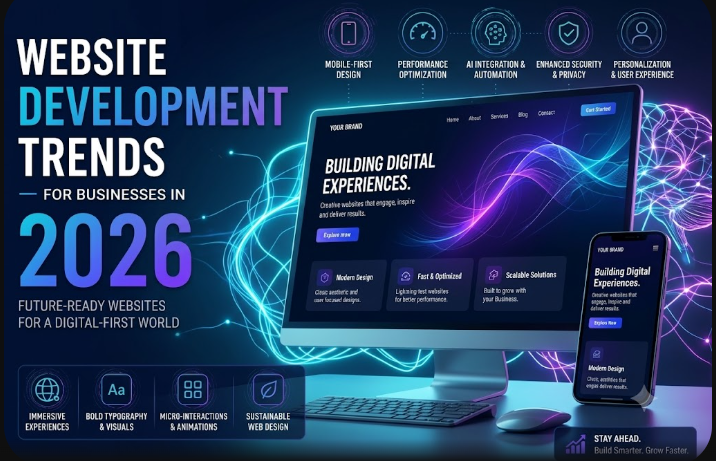
A business website is no longer just an online brochure. In 2026, it is a major part of a company's digital presence, customer experience, marketing strategy, and sales funnel.
As customer expectations continue to change, businesses need websites that are fast, secure, mobile-friendly, personalized, and easy to use. At the same time, technologies such as artificial intelligence, automation, voice interfaces, and advanced analytics are changing how websites are developed and managed.
For businesses planning a new website or looking to improve an existing one, understanding the latest website development trends in 2026 can help create a stronger digital experience and support long-term growth.
In this article, we explore the major web development trends businesses should know in 2026 and how they can influence business websites.
1. AI-Powered Website Development
Artificial intelligence is becoming an increasingly important part of website development.
Developers and businesses can use AI tools to support different stages of website creation, including coding, content generation, testing, personalization, and customer support.
AI can help developers identify coding errors, generate repetitive code, analyze user behavior, and automate certain development tasks. Businesses can also use AI-powered features such as intelligent search, personalized recommendations, and automated customer support.
For example, an e-commerce website can analyze customer behavior and recommend relevant products based on browsing or purchase patterns.
However, AI should complement human expertise rather than completely replace it. Businesses still need developers, designers, and marketers to ensure that websites align with their brand, business goals, security requirements, and customer expectations.
2. Mobile-First Website Design
Mobile-first design continues to be one of the most important website development trends in 2026.
A large portion of internet activity takes place on smartphones. This means businesses cannot treat mobile responsiveness as an optional feature.
A mobile-first website is designed with smaller screens and touch-based navigation in mind before being adapted to larger screens.
Important elements include:
- Responsive layouts
- Easy-to-use navigation
- Fast loading times
- Readable typography
- Touch-friendly buttons
- Optimized images
- Mobile-friendly forms
A poor mobile experience can make it difficult for visitors to navigate a website, find information, or complete a purchase.
Businesses should therefore test their websites across different screen sizes and devices before launching them.
3. Faster Website Performance
Website speed has become a critical part of the digital experience.
Users expect websites to load quickly. Slow websites can increase frustration and may lead visitors to leave before interacting with the business.
In 2026, developers are focusing more heavily on website performance through techniques such as:
- Image compression
- Lazy loading
- Code optimization
- Content delivery networks
- Browser caching
- Efficient hosting
- Minimizing unnecessary scripts
Performance optimization is particularly important for e-commerce websites, SaaS platforms, landing pages, and websites that receive traffic from paid advertising.
Businesses should regularly monitor website performance rather than optimizing only when a website is initially launched.
4. Core Web Vitals and User Experience
Website development is increasingly focused on the relationship between technical performance and user experience.
Google's Core Web Vitals provide useful measurements related to loading performance, responsiveness, and visual stability.
Developers need to consider whether pages load efficiently, respond quickly to user interactions, and remain visually stable while loading.
But good user experience goes beyond technical metrics.
A successful website should also make it easy for visitors to answer questions such as:
- What does this business offer?
- Why should I choose it?
- Where can I find the information I need?
- How can I contact the company?
- What should I do next?
Combining technical performance with clear design and intuitive navigation can create a stronger overall website experience.
5. Personalized User Experiences
Website personalization is becoming increasingly valuable for businesses.
Instead of showing exactly the same experience to every visitor, websites can use available data and behavioral signals to provide more relevant content.
For example, an online store may recommend products based on previous browsing activity, while a B2B website may display different content based on the visitor's interests or stage in the buying journey.
Personalization can be used for:
- Product recommendations
- Content suggestions
- Location-based experiences
- Personalized offers
- Returning visitor experiences
- Relevant calls-to-action
Businesses should implement personalization carefully and transparently while respecting privacy and applicable data protection requirements.
6. Voice Search and Conversational Interfaces
Voice technology continues to influence how people interact with digital platforms.
Users increasingly use voice assistants and conversational interfaces to search for information, ask questions, and perform tasks.
Businesses can prepare their websites by creating clear, conversational content that answers common customer questions.
For example, instead of focusing exclusively on short keywords, businesses can create content around natural questions such as:
"How much does website development cost for a small business?"
or
"How can a business improve website loading speed?"
Conversational interfaces and AI-powered chatbots can also help visitors find information without navigating through multiple pages.
7. AI Chatbots and Smart Customer Support
Customer expectations for quick responses are increasing.
AI-powered chatbots can help businesses provide support outside traditional working hours. They can answer frequently asked questions, guide users toward relevant pages, collect basic information, and assist with common customer queries.
For example, a software company could use a chatbot to answer questions about pricing, features, integrations, and product documentation.
However, chatbots should not create unnecessary friction. Businesses should provide a clear path to human support when a question requires personal assistance or more complex problem-solving.
8. Stronger Website Security
Cybersecurity is becoming increasingly important as businesses collect more customer information and rely on digital platforms.
A website security strategy may include:
- HTTPS and SSL certificates
- Secure authentication
- Regular software updates
- Strong password policies
- Secure APIs
- Data encryption
- Vulnerability testing
- Regular backups
- Access control
Businesses should also pay attention to third-party plugins and integrations because outdated or poorly maintained components can create security risks.
Security should be considered during the development process rather than treated as an afterthought.
9. Accessibility as a Development Priority
Website accessibility is becoming a more important consideration for businesses.
An accessible website allows people with different abilities to navigate and interact with digital content more easily.
Developers can improve accessibility through features such as:
- Keyboard-friendly navigation
- Alternative text for images
- Clear color contrast
- Descriptive links
- Accessible forms
- Proper heading structures
- Captions for relevant multimedia
Accessibility can also improve usability for the wider audience.
Businesses should consider accessibility from the beginning of the website development process rather than attempting to add it later.
10. Headless and Flexible Website Architecture
Headless architecture is another trend gaining attention among businesses that need flexibility.
Traditional websites often connect the frontend presentation layer directly with the backend or content management system. A headless approach separates these components.
This allows businesses to deliver content across multiple platforms and digital touchpoints through APIs.
For example, the same content could potentially be used across:
- Websites
- Mobile applications
- E-commerce platforms
- Digital displays
- Other connected experiences
Headless development can provide greater flexibility, although it may also require more technical expertise and careful architecture planning.
Businesses should consider whether this approach actually matches their requirements before adopting it.
11. Progressive Web Applications
Progressive Web Applications, or PWAs, combine some characteristics of websites and mobile applications.
PWAs can provide features such as fast loading, responsive experiences, and certain offline capabilities depending on implementation and browser support.
They can be useful for businesses that want an app-like web experience without necessarily developing separate native applications for every platform.
For businesses with frequent returning users, e-commerce platforms, content services, or web-based applications, PWAs may be worth evaluating.
12. Motion Design and Micro-Interactions
Modern websites are increasingly using subtle animations and micro-interactions to make interfaces more engaging.
Examples include:
- Button animations
- Hover effects
- Scroll-based transitions
- Loading animations
- Interactive menus
- Visual feedback after form submissions
When used appropriately, these elements can help users understand how an interface works.
However, excessive animation can slow down a website or distract users from important information.
The goal should be to use motion to improve usability rather than simply adding visual effects.
13. Search-Friendly Website Architecture
SEO and website development are becoming increasingly connected.
A visually attractive website is not enough if search engines and users cannot easily understand its structure.
Developers should consider:
- Clean URLs
- Logical website architecture
- Proper heading structures
- Mobile responsiveness
- Fast loading speeds
- Structured data where appropriate
- Internal linking
- Crawlability
- Optimized metadata
Technical SEO should be considered during development instead of being added only after a website is launched.
A strong technical foundation can make it easier for search engines to discover and understand website content.
14. Sustainable Web Development
Sustainability is also entering conversations around website development.
Large files, unnecessary scripts, inefficient code, and heavy website experiences can require more processing and data transfer.
Developers can work toward more efficient websites by:
- Compressing media
- Reducing unnecessary scripts
- Optimizing code
- Using efficient hosting solutions
- Limiting unnecessary third-party resources
Creating a lightweight website can benefit both performance and resource efficiency.
15. Data-Driven Website Optimization
Launching a website is not the end of development.
Businesses can use analytics and user behavior data to understand how visitors interact with their websites.
Useful metrics can include:
- Traffic sources
- Engagement
- Conversion rate
- Bounce or engagement patterns
- Form submissions
- Landing page performance
- User journeys
Businesses can then use these insights to test different headlines, layouts, calls-to-action, forms, and content.
This creates a continuous improvement cycle where the website evolves based on actual user behavior rather than assumptions.
What Do These Website Development Trends Mean for Businesses?
The biggest change in website development is the shift from simply creating websites to building digital experiences.
Businesses in 2026 need to think beyond appearance. A successful website should combine:
Performance + Security + User Experience + Accessibility + SEO + Personalization + Scalability
Before investing in a new website, businesses should clearly define their goals.
For example:
- Is the website designed to generate leads?
- Is it selling products?
- Is it supporting an existing sales team?
- Is it providing information?
- Is it building brand credibility?
- Does it need integrations with CRM or other business software?
The answers can determine which technologies and development approaches are appropriate.
How Devobyte Can Help
At Devobyte, we understand that every business has different digital requirements.
From website development and digital solutions to SEO and digital marketing, businesses need technology that supports their broader growth strategy.
Our approach focuses on creating websites that are not only visually professional but also functional, responsive, user-friendly, and aligned with business objectives.
Whether you are building a website from scratch, redesigning an outdated website, or improving an existing digital platform, the right development strategy can help create a stronger online presence.
Conclusion
Website development in 2026 is moving toward smarter, faster, more secure, accessible, and personalized digital experiences.
AI-powered development, mobile-first design, website performance, personalization, cybersecurity, accessibility, conversational interfaces, flexible architecture, and data-driven optimization are some of the major trends businesses should understand.
However, businesses should not adopt every new technology simply because it is trending. The right approach is to identify business goals, understand customer needs, and select technologies that provide meaningful value.
A modern website should ultimately do more than look good. It should help businesses attract visitors, communicate their value, generate leads, support customers, and create a strong digital foundation for future growth.
Ready to build or improve your business website? Connect with Devobyte to explore website development solutions designed around your business goals.