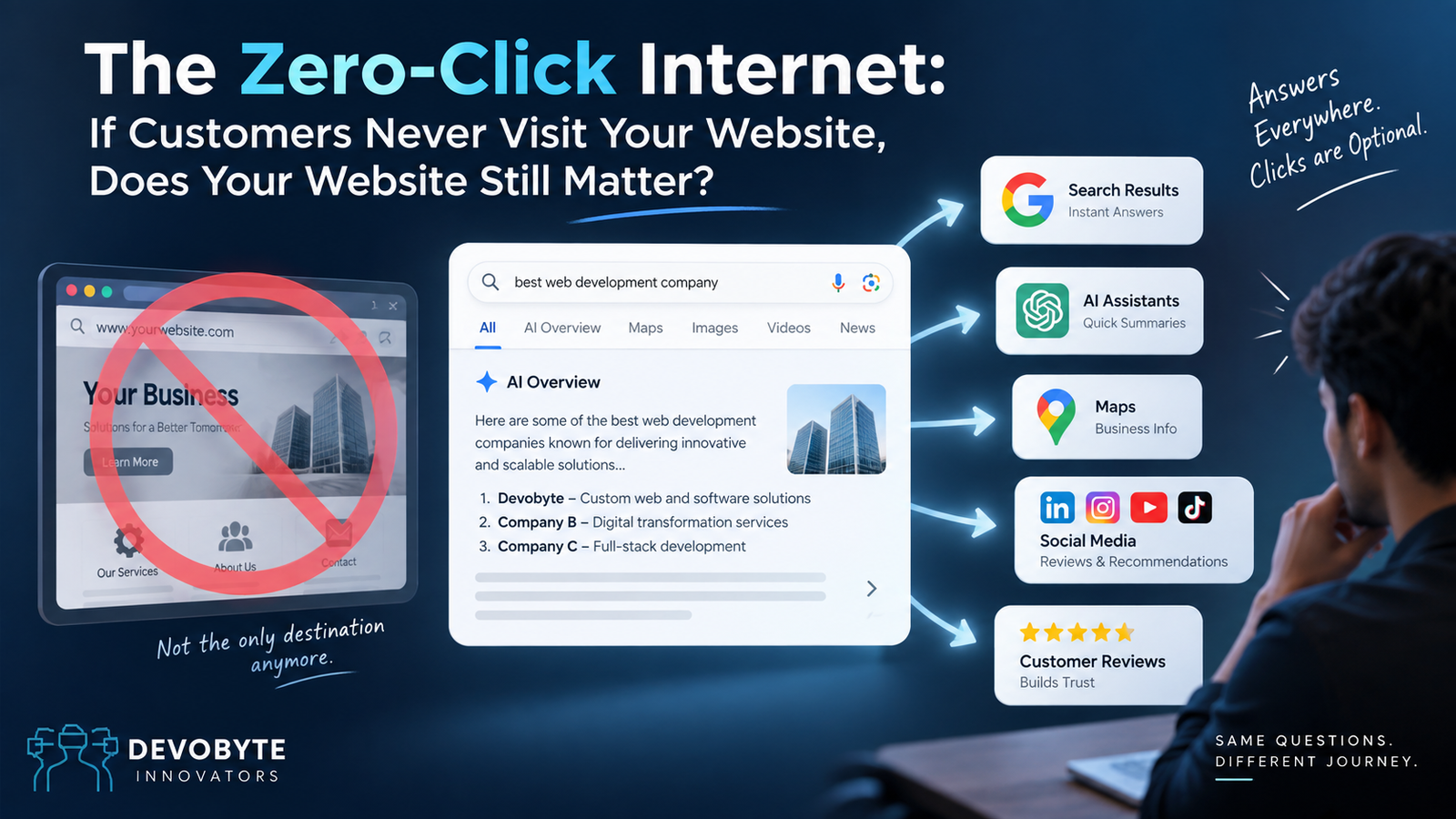
The internet is entering a new phase. For years, the website was the centre of a business’s digital presence. A customer would search for a product or service, click a website, read about the business, compare options, and eventually make a decision. Today, that journey is changing. Customers can increasingly get answers without visiting a website at all. Search engines provide direct answers, social platforms influence buying decisions, maps show business information instantly, and AI tools can summarize information from multiple sources within seconds. This shift is creating what many marketers are calling the zero-click internet.
The idea behind zero-click is simple: the user gets the information they need without clicking through to another website. A person searching for the best web development company, for example, may see business listings, reviews, summaries, ratings, and recommendations directly in the search results. Someone asking an AI assistant for recommendations may receive a shortlist without opening ten different websites. The traditional journey from search to website to conversion is therefore becoming less predictable.
This raises an important question for businesses: if customers do not visit your website, does your website still matter? The answer is yes, but its role is changing. A website is no longer just a destination where customers consume information. It is becoming a foundation for a much larger digital presence. Your website provides the information, credibility, brand identity, products, services, and data that other digital platforms can discover, understand, and use.
One of the biggest changes is the way people search for information. Traditional search was largely based on keywords. A user might type “best digital marketing company in Mumbai” and then browse through several results. With AI-powered search and conversational tools, users can ask much longer and more specific questions. They might ask which digital marketing company is suitable for a small business with a limited budget, or which company specializes in a particular industry. The technology then attempts to provide a direct answer rather than simply presenting a list of websites.
This means businesses need to think beyond ranking for individual keywords. They need to become useful sources of information. Clear service pages, detailed explanations, original insights, frequently asked questions, case studies, customer reviews, and well-structured information can all help a business establish a stronger digital presence. The goal is no longer simply to attract a click. The goal is to become a trusted source that can be discovered, understood, and recommended across different digital environments.
This does not mean traditional SEO is disappearing. Search engine optimization is still important because search engines need reliable information to understand businesses and their websites. What is changing is the definition of visibility. In the past, success might have been measured primarily through rankings, impressions, clicks, and website traffic. In the zero-click environment, businesses also need to consider whether their brand appears in answers, business listings, featured results, reviews, maps, social conversations, and AI-generated recommendations.
Brand recognition becomes especially important in this environment. Imagine a customer sees your company mentioned several times while researching a problem. They may encounter your business in a search result, see positive reviews on another platform, watch one of your videos, and later hear the brand recommended by an AI assistant. They may not visit the website during every step, but every interaction contributes to their perception of the company. When they are finally ready to buy, the brand they already recognize has an advantage.
This is why businesses should stop thinking of their website as an isolated digital property. It should work together with the rest of the digital ecosystem. Social media can build awareness and demonstrate expertise. Reviews can build trust. Business listings can provide accurate local information. Helpful content can answer customer questions. Videos can explain complicated products and services. Email can maintain relationships with existing customers. The website can bring these elements together and provide a reliable source of detailed information.
The quality of the website still matters because the final decision often requires more than a short answer. A search result might tell someone what a company does, but the website can show how the company works. It can demonstrate expertise through case studies, explain services in detail, showcase previous projects, answer common questions, and provide a clear path to contact the business. In other words, zero-click does not eliminate the website. It changes when and why people visit it.
There is also another important shift: customers are becoming less patient. If they eventually reach a website and cannot quickly understand what the business offers, why it is different, or how to take the next step, they are likely to leave. A website therefore needs to perform both as a source of information and as a conversion experience. Speed, mobile responsiveness, clear navigation, useful content, strong calls to action, and a professional design all become increasingly important.
Businesses should also pay attention to the consistency of their information across the internet. If a company has one address on its website, another address on a business listing, and outdated information on a social media profile, it can create confusion for both customers and digital systems trying to understand the business. Accurate names, contact details, services, descriptions, and other important information should be maintained consistently across relevant platforms.
The rise of the zero-click internet also creates an opportunity for smaller businesses. A company does not necessarily need the largest advertising budget to become visible. Businesses that consistently answer real customer questions, demonstrate expertise, collect genuine reviews, publish useful content, and maintain accurate digital information can build authority over time. Instead of competing only for expensive clicks, they can compete for trust and relevance.
The most important change, therefore, is a change in mindset. Businesses should stop asking only, “How do we get more people to visit our website?” and start asking, “How do we make our business visible and trustworthy wherever customers are looking for answers?” Website traffic remains valuable, but it is only one measurement of digital success.
The future of digital marketing will not be completely clickless. People will still visit websites when they want to research a company, compare products, read detailed information, make purchases, or contact a business. However, the first interaction may increasingly happen somewhere else. A customer might discover your brand through an AI answer, a search result, a review, a video, a social media post, or a recommendation before ever seeing your homepage.
That is why the website still matters. It is no longer simply the place where your digital presence begins and ends. It is the foundation that supports your presence across the wider internet. In the zero-click era, the winning businesses will not be those that only build websites that people visit. They will be the ones that build digital identities people can discover, understand, trust, and remember—even when they never click.