In today's competitive business environment, technology has become an essential part of how organizations operate, communicate, and grow. Software solutions enable businesses to manage daily operations, automate repetitive tasks, analyze information, communicate with customers, and make more informed decisions.
From small businesses to large enterprises, organizations are increasingly adopting software solutions to improve efficiency and reduce operational challenges. Whether it is customer relationship management, accounting, human resource management, inventory tracking, or business analytics, the right software can simplify complex processes and support sustainable growth.
What Are Software Solutions?
Software solutions are applications, platforms, or customized software systems designed to solve specific business or operational problems. They can help organizations manage processes, store and analyze data, automate workflows, and improve collaboration.
Unlike traditional manual processes, software-based systems allow businesses to handle large amounts of information more efficiently. Many modern solutions can also integrate different departments, giving businesses a centralized system for managing their operations.
Software solutions can be developed for specific business requirements or purchased as ready-to-use products. The choice generally depends on the organization's size, budget, objectives, industry, and technical requirements.
Major Types of Software Solutions
Businesses can choose from different types of software solutions depending on their needs.
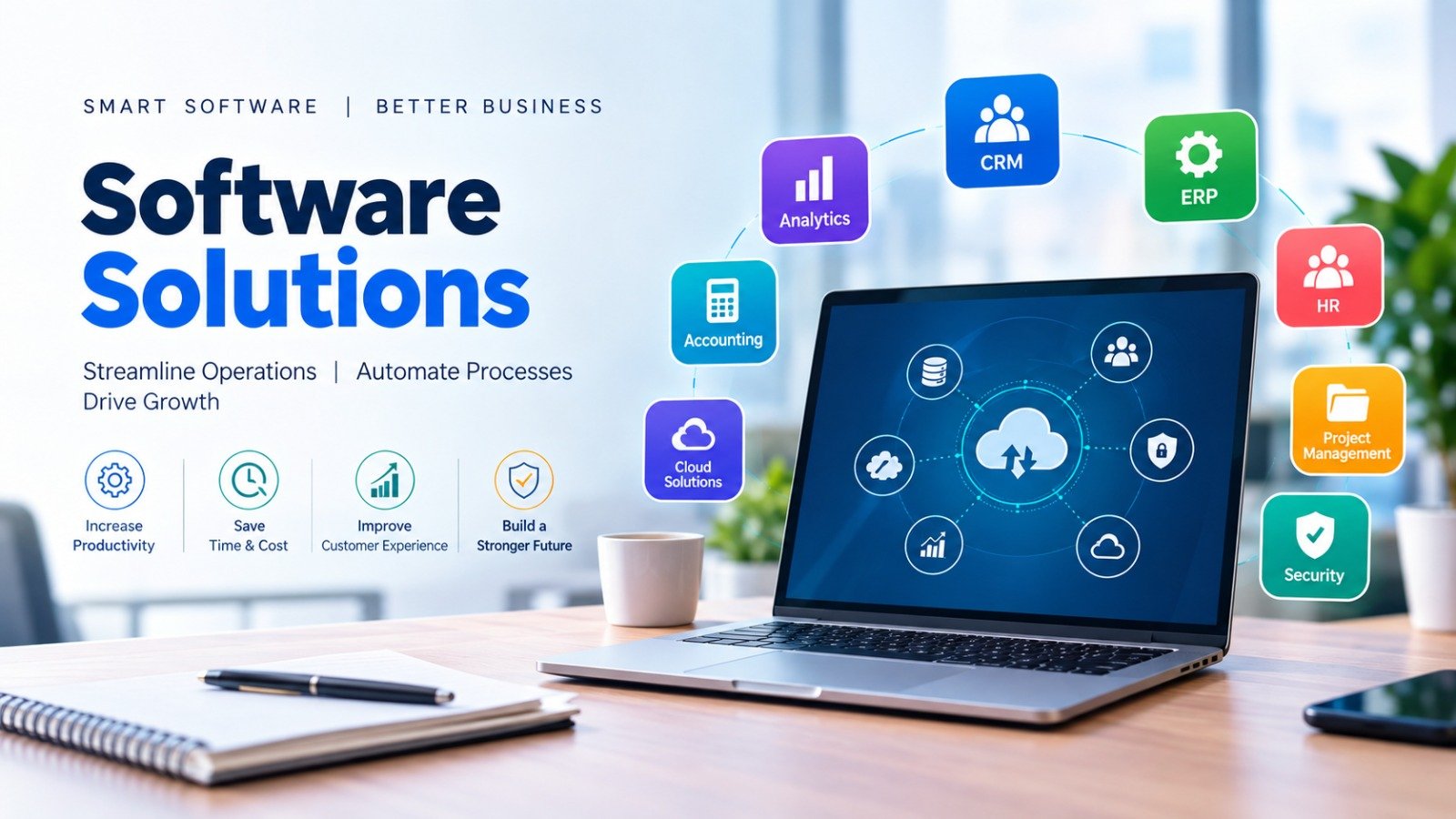
1. Customer Relationship Management Software
CRM software helps businesses organize customer information, track interactions, manage leads, and support sales activities. It can help sales and marketing teams maintain better visibility into the customer journey.
CRM solutions are particularly useful for businesses that manage a large number of leads and customers.
2. Enterprise Resource Planning Software
ERP software connects different business functions through a centralized system. It may include areas such as finance, inventory, procurement, supply chain, human resources, and operations.
By bringing information together, ERP solutions can help businesses improve coordination between departments.
3. Accounting and Financial Software
Financial software helps organizations manage accounting activities such as invoices, expenses, payments, financial records, and reporting.
Automating financial processes can reduce repetitive administrative work and make financial information easier to organize and access.
4. Human Resource Management Software
HR software supports employee-related processes, including recruitment, attendance, payroll, employee records, performance management, and leave management.
These solutions can help HR teams reduce paperwork and manage employee information more systematically.
5. Project Management Software
Project management platforms help teams plan projects, assign tasks, monitor deadlines, communicate, and track progress.
They are especially useful for organizations where multiple employees or teams need to collaborate on the same projects.
6. Business Intelligence and Analytics Software
Business intelligence solutions transform business data into reports, dashboards, and insights. Managers can use these tools to understand sales performance, customer behavior, operational efficiency, and other important business metrics.
Data-driven analysis can support more informed business decisions.
Benefits of Software Solutions for Businesses
Implementing the right software solution can provide several advantages.
1 Improved Productivity
Software can automate repetitive activities and reduce the amount of time employees spend on manual tasks. This allows teams to focus more on activities that require creativity, analysis, and decision-making.
2 Business Process Automation
Automation is one of the major advantages of modern software. Tasks such as sending notifications, generating reports, processing invoices, managing leads, and updating records can often be automated.
3 Better Data Management
Businesses generate significant amounts of data every day. Software solutions provide structured systems for storing, organizing, accessing, and analyzing this information.
4 Improved Customer Experience
Businesses can use software to understand customer requirements, respond faster to inquiries, personalize communication, and maintain customer records.
A better-organized customer experience can contribute to stronger customer relationships.
5 Enhanced Collaboration
Cloud-based software solutions allow employees to access information and collaborate from different locations. This can be particularly valuable for remote and hybrid teams.
6 Cost and Time Efficiency
Although implementing software requires investment, automation can reduce manual effort and improve resource utilization over time. Businesses can also reduce errors associated with repetitive manual processes.
Cloud-Based Software Solutions
Cloud technology has significantly changed how businesses use software. Instead of installing and maintaining applications entirely on local computers, organizations can use cloud-based platforms through the internet.
Cloud software can provide benefits such as remote accessibility, easier updates, centralized data management, and flexible scalability.
For growing businesses, cloud-based solutions can provide an alternative to maintaining extensive in-house IT infrastructure.
Customized vs. Ready-Made Software Solutions
Businesses generally have two broad options: custom software solutions and ready-made software products.
Ready-made software is designed for a broad group of users and usually provides standard features. It can be quicker to implement and may require less initial development.
Customized software, on the other hand, is developed around the specific requirements of an organization. It can provide greater flexibility but may involve higher development costs and longer implementation periods.
The appropriate choice depends on factors such as business requirements, budget, scalability, integration needs, and available technical resources.
How to Choose the Right Software Solution
Selecting the right software requires more than simply comparing features. Businesses should first identify the problem they want the software to solve.
Important factors to consider include:
Business requirements
Ease of use
Scalability
Security
Integration capabilities
Pricing and total cost of ownership
Customer support
Data management
Customization options
Mobile and cloud accessibility
Businesses should also consider whether the software can continue supporting their needs as the organization grows.
The Role of Software Solutions in Digital Transformation
Digital transformation is changing how organizations operate and interact with customers. Software solutions are at the center of this transformation because they provide the tools required to automate processes, connect teams, analyze data, and deliver digital experiences.
Technologies such as artificial intelligence, cloud computing, automation, data analytics, and cybersecurity are also becoming increasingly integrated into modern software platforms.
As businesses continue to adopt digital technologies, software solutions are expected to play an increasingly important role in operational efficiency and business innovation.
Future of Software Solutions
The future of software is increasingly focused on automation, intelligent decision-making, integration, and personalization. AI-powered features are being incorporated into business applications to assist with tasks such as data analysis, customer support, content generation, forecasting, and workflow automation.
Low-code and no-code platforms are also making it easier for organizations to develop certain applications without extensive programming knowledge.
At the same time, cybersecurity and data privacy will remain important considerations as businesses become increasingly dependent on digital systems.
Conclusion
Software solutions have become an important component of modern business operations. From CRM and ERP systems to analytics, accounting, HR, and project management platforms, software can help organizations automate processes, manage information, improve collaboration, and enhance customer experiences.
However, successful implementation depends on choosing a solution that matches the organization's actual requirements. Businesses should evaluate functionality, security, scalability, integration, cost, and long-term usability before making a decision.
As digital transformation continues, organizations that effectively use software solutions can create more efficient processes and build a stronger foundation for future growth.