“We need an app.” It is a phrase many businesses hear or even say when they start thinking about digital growth. Having a mobile application can certainly provide a convenient and personalized experience, but building an app should not automatically be considered the next step for every business. The real question is not whether a business can build an app, but whether its customers actually need one. In many cases, a well-designed, responsive website can provide everything a business needs while being easier to access, maintain, and update.
For many small and medium-sized businesses, a website can be a complete digital solution. A restaurant, for example, may need to display its menu, provide opening hours, accept reservations, receive orders, and allow customers to get in touch. A consultant may simply need a professional platform to showcase their services, experience, and contact information. A local bakery may want customers to browse products, check prices, place orders, and find its location. These requirements can often be handled effectively through a responsive website that works across smartphones, tablets, and computers. Customers can access it instantly through a browser without downloading an application or using additional storage on their device.
Another important consideration is the long-term investment involved in building an app. Development is only the beginning. Businesses also need to account for maintenance, security updates, bug fixes, backend infrastructure, compatibility with new operating system versions, and improvements based on customer feedback. If an app is being developed for a business whose customers may only use the service occasionally, the investment may not provide enough additional value compared with a website. A website can also be updated centrally, allowing changes to content, products, pricing, and services to become available to users without requiring them to download a new version.
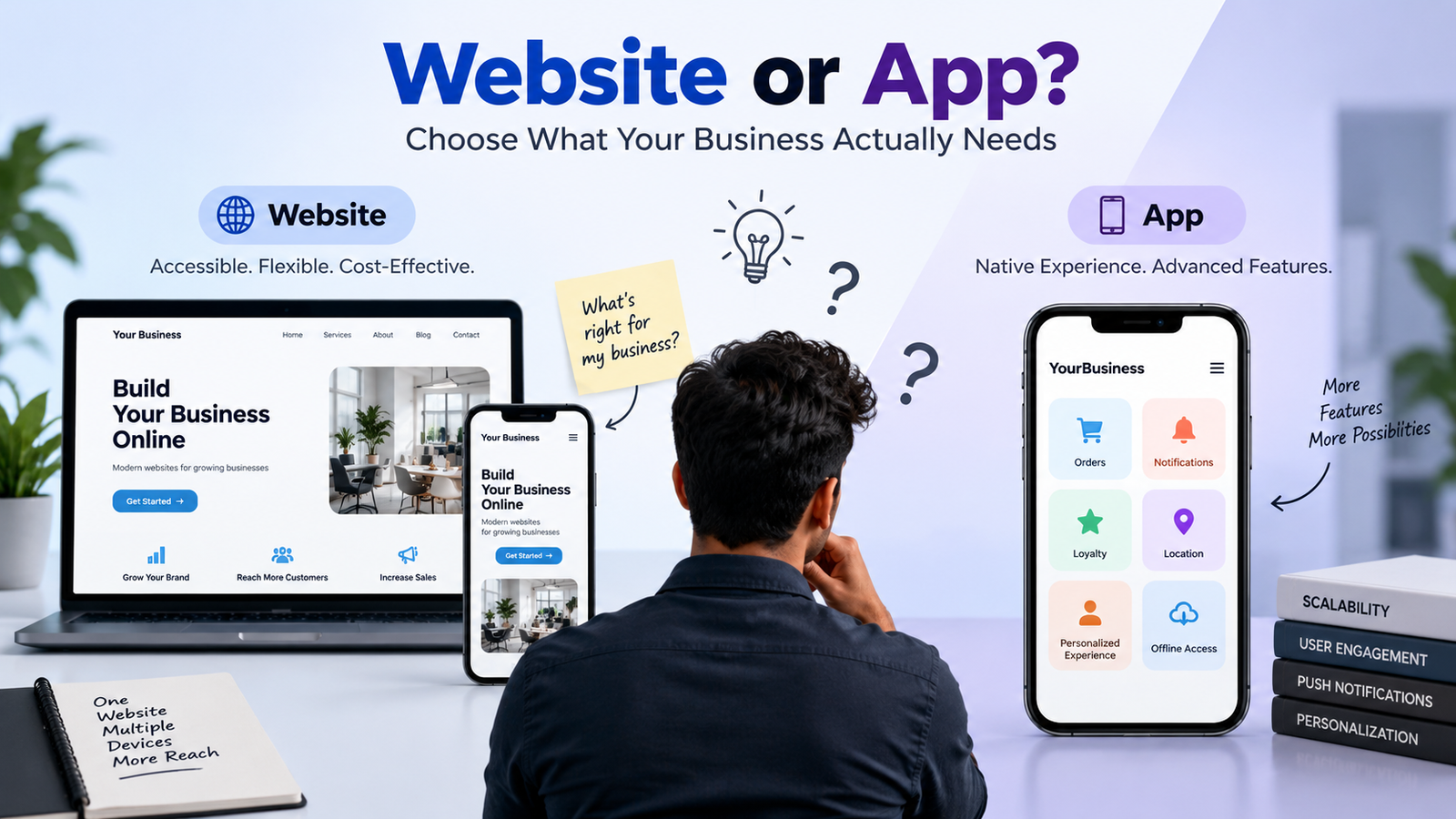
However, this does not mean that mobile applications are unnecessary. For businesses where customers interact with the service frequently, an app can offer features that create a more personalized experience. Push notifications, loyalty programs, personalized recommendations, location-based services, offline functionality, and device-specific features can all make an application useful. Businesses operating in areas such as food delivery, banking, fitness, e-commerce, and transportation may have stronger reasons to develop an app because customers often return to these services regularly and may benefit from a dedicated experience.
Consider a small bakery that is planning to expand its online presence. If its customers mainly want to view the menu, check prices, place an order, and contact the bakery, a responsive website with an online ordering system may be enough. Creating a dedicated app at this stage could introduce additional development and maintenance requirements without solving a major customer problem. However, if the bakery grows and introduces a loyalty program, personalized discounts, frequent notifications, subscription-based orders, and a large base of returning customers, an app could become a more practical investment.
Businesses should also avoid choosing technology simply because competitors are using it. A technology decision should begin with the customer journey and the problem that needs to be solved. Businesses can ask themselves how frequently customers will use the service, what features customers actually need, whether those features require a mobile application, and whether the business has the resources to maintain the platform over time. These questions can help prevent businesses from spending money on technology that provides little additional value.
There is also a middle ground between a traditional website and a full mobile application. Modern web technologies can create fast, responsive, and highly interactive experiences that work across devices. Depending on the requirements, businesses can also explore solutions such as Progressive Web Apps, which can provide some app-like capabilities while still being accessed through the web. This allows businesses to consider different technical approaches instead of treating a native mobile application as the only option.
Ultimately, digital transformation is not about building the most technology possible. It is about choosing technology that solves a genuine problem. An app can be an excellent investment when it improves the customer experience and provides functionality that a website cannot deliver effectively. But for many businesses, a well-built website may be faster to launch, easier to maintain, and more than capable of meeting customer expectations. The smartest digital solution is not necessarily the most complicated one. It is the solution that fits the business, serves its customers, and provides value over the long term.