
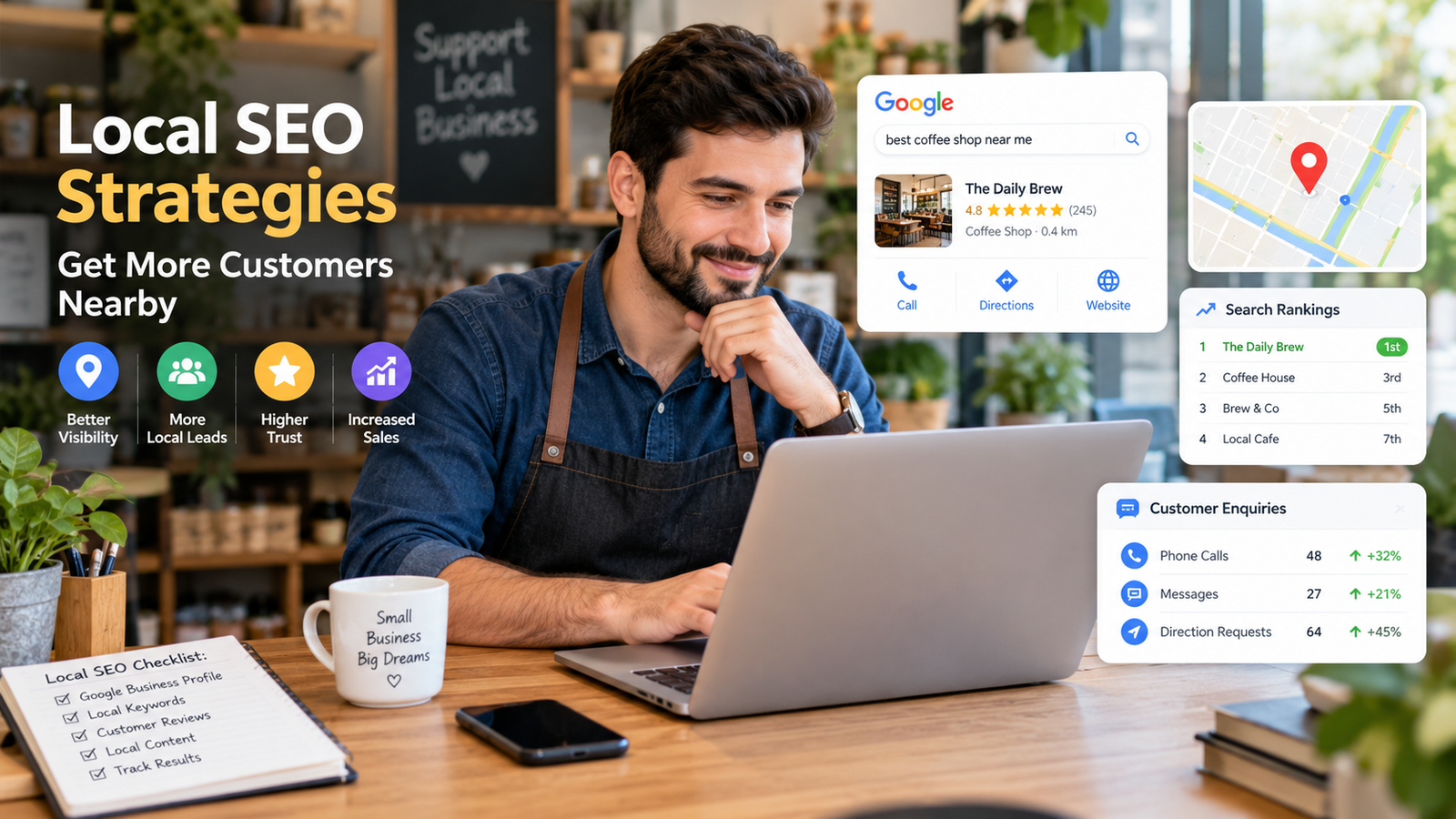
Local SEO strategies help businesses improve their visibility in search results when people look for products or services in a specific area. Whether you run a restaurant, retail store, consultancy, salon, repair service, or digital agency, appearing in relevant local searches can help you connect with potential customers who are already looking for what you offer.
Today, many customers use search engines to find nearby businesses, compare reviews, check opening hours, and get directions before making a purchase. If your business does not appear prominently in these searches, you may miss valuable opportunities to attract new customers.
Local search engine optimization focuses on improving your business's online presence for geographically relevant searches. With the right approach, you can increase local visibility, build trust, generate qualified leads, and encourage more people to visit your store or contact your team.
In this guide, we explore practical local SEO strategies that businesses can implement to reach more nearby customers and build a stronger local presence.
1. Optimize Your Google Business Profile
One of the most important local SEO strategies is optimizing your Google Business Profile. This profile helps your business appear on Google Search and Google Maps when people search for relevant products or services.
An incomplete or outdated profile can make it harder for potential customers to understand what your business offers.
To improve your profile:
-
Complete every relevant section: Add your business name, address or service area, phone number, website, business hours, and other requested details.
-
Choose the right categories: Select the primary category that best describes your business and add relevant secondary categories when appropriate.
-
Write a clear business description: Explain your services, target customers, and what makes your business useful.
-
Upload authentic photos: Share high-quality images of your premises, products, team, or completed work.
-
Keep information updated: Update holiday hours, contact details, and service information whenever changes occur.
-
Add services and products: Where available, provide accurate details about what customers can purchase or book.
Consistency and accuracy help customers find the information they need. Avoid adding promotional keywords to your business name unless they are genuinely part of its real-world name.
2. Target Local Keywords That Match Customer Intent
Keyword research helps you understand how potential customers search for businesses in their area. Instead of targeting only broad keywords, identify search phrases that combine your service with a location or specific customer need.
For example, a digital marketing agency in Delhi might target phrases such as:
-
Digital marketing agency in Delhi
-
SEO services in Delhi
-
Local SEO company in Delhi
-
Affordable SEO services for small businesses in Delhi
A plumber might focus on searches such as “emergency plumber in Ghaziabad” or “bathroom repair near me.”
When selecting keywords, consider the intent behind each search. Someone searching for “what is digital marketing” may want information, while someone searching for “digital marketing agency near me” may be ready to contact a provider.
How to implement local keyword research:
-
List your primary services and products.
-
Identify the cities, neighbourhoods, or service areas you genuinely serve.
-
Research relevant search terms using Google autocomplete, Google Trends, and keyword research tools.
-
Review competitors' service pages and the language customers use in reviews.
-
Incorporate relevant phrases naturally into page titles, headings, descriptions, and website content.
Avoid stuffing location names into every sentence. Your content should read naturally and help customers make informed decisions.
3. Create Dedicated Location Pages
If your business serves multiple cities or neighbourhoods, dedicated location pages can help explain which services are available in each area.
For example, an agency serving Delhi, Noida, and Ghaziabad could create separate pages describing its services and local expertise in each location.
An effective location page should include:
-
A clear heading mentioning the service and location.
-
Details about the services available in that area.
-
Relevant local examples, projects, or customer testimonials.
-
Accurate contact information and service availability.
-
Useful frequently asked questions.
-
A clear call to action, such as requesting a quote or booking a consultation.
Each page should provide distinct, genuinely useful information. Creating dozens of nearly identical pages with only the city name changed can produce poor-quality content and may harm your search performance.
For businesses with a single physical location, a well-optimized contact page and service pages may be sufficient.
4. Build Trust Through Genuine Customer Reviews
Customer reviews influence how people evaluate local businesses. Positive, detailed reviews can strengthen credibility and help potential customers feel more confident about contacting you.
Encourage satisfied customers to share honest feedback on Google and other relevant review platforms.
You can request reviews through a follow-up email, a message after a completed service, or a QR code provided at your premises.
To manage reviews effectively:
-
Ask customers for honest feedback without pressuring them.
-
Respond professionally to both positive and negative reviews.
-
Thank customers for specific comments about their experience.
-
Address complaints constructively and offer an appropriate resolution.
-
Use feedback to identify recurring service problems.
Never purchase fake reviews, offer incentives in exchange for positive ratings, or create reviews for your own business. These practices can undermine trust and violate platform policies.
Reviews should reflect real customer experiences rather than being treated as a shortcut to higher rankings.
5. Improve Your Website's Mobile Experience
Many local searches happen on mobile devices, where users often want immediate answers. A slow, difficult-to-navigate website can cause potential customers to leave before contacting your business.
Your website should make essential information easy to find on smaller screens.
Focus on the following improvements:
-
Use a responsive design that adapts to different screen sizes.
-
Improve page loading speed and address performance issues.
-
Make phone numbers clickable for easy calling.
-
Keep contact forms short and straightforward.
-
Display business hours, service areas, and contact details clearly.
-
Use readable fonts, accessible colours, and simple navigation.
-
Place clear calls to action on important pages.
Check your website on several mobile devices and use Google's PageSpeed Insights to identify performance improvements.
A strong mobile experience supports local SEO by helping visitors find information and complete useful actions once they reach your website.
6. Maintain Consistent Business Information
Accurate business information helps customers identify and contact your business across the internet.
Your business name, address, phone number, and website details should be consistent wherever they appear, including your website, Google Business Profile, social media pages, and relevant business directories.
This is commonly called NAP consistency, referring to name, address, and phone number.
To maintain consistency:
-
Use your correct business name and contact details.
-
Update old addresses and phone numbers after any change.
-
Remove duplicate or outdated directory listings where possible.
-
Check important local directories and industry-specific platforms.
-
Make sure your website's contact page matches your current business information.
Consistency does not mean every listing must follow an identical format in every field. The priority is ensuring that customers and search engines can confidently identify the same business.
7. Publish Helpful, Locally Relevant Content
Content marketing can support your local SEO strategy by answering questions that customers in your target area actually ask.
Instead of publishing only general industry articles, create content that connects your expertise with local customer needs.
For example, a real estate agency could publish a guide to choosing a neighbourhood in its city. A home services company could explain seasonal maintenance requirements for local homes. A digital marketing agency could share a practical guide to improving online visibility for businesses in a specific market.
Useful content formats include:
-
Local industry guides.
-
Frequently asked questions about your services.
-
Customer success stories and case studies.
-
Community event coverage relevant to your business.
-
Service comparison articles.
-
Practical tips addressing common local problems.
Focus on providing real value rather than repeating location keywords. Locally relevant content can attract visitors, demonstrate expertise, and give potential customers more reasons to trust your business.
8. Earn Relevant Local Backlinks
Backlinks are links from other websites to your website. Relevant links can help search engines discover your content and understand your business's place within its industry and community.
For local businesses, earning links from credible local organizations can be especially useful.
Consider these approaches:
-
Partner with local businesses on community initiatives.
-
Sponsor relevant events or educational activities.
-
Contribute expert articles to reputable industry publications.
-
Join legitimate local business associations.
-
Share original research, useful guides, or case studies that others may reference.
-
Participate in community projects that naturally generate online coverage.
Prioritize relevance and editorial quality over the number of links. Avoid buying large quantities of low-quality backlinks or participating in manipulative link schemes.
The goal is to build genuine relationships and earn links that make sense for your business.
9. Use Local Business Schema Markup
Schema markup is structured data that helps search engines understand information on your website. Local businesses can use appropriate structured data to describe details such as their business type, address, telephone number, opening hours, and website.
For example, a restaurant can provide relevant information about its location and opening hours, while a professional service provider can identify the appropriate business category.
To implement structured data:
-
Select the schema type that accurately describes your business.
-
Add eligible and accurate details to your website's code.
-
Ensure the information matches what customers can see on the page.
-
Test the markup using Google's Rich Results Test where applicable and validate it with Schema.org's validator.
-
Monitor Search Console for relevant issues.
Schema markup does not guarantee better rankings or enhanced search results. It helps search engines interpret your information, but eligibility for rich results depends on Google's requirements.
10. Optimize for Voice and “Near Me” Searches
Customers frequently use conversational queries when searching for nearby services, including searches containing phrases such as “near me,” “open now,” and “best service in my area.”
You cannot directly optimize for every possible spoken query, but you can make your website more useful for the needs behind these searches.
For example, a customer might search for:
-
Which dentist is open on Sunday near me?
-
Where can I find an affordable car repair service?
-
Which digital marketing agency serves small businesses in Noida?
To address these needs, provide accurate opening hours, service details, location information, pricing information where appropriate, and clear answers to common questions.
Use natural language in headings and FAQs. Keep your Google Business Profile updated and make it easy for visitors to contact your team.
The objective is not to repeat the phrase “near me” excessively. It is to provide accurate, useful information for people looking for services nearby.
11. Track Local SEO Performance
Local SEO should be measured regularly so you can understand which activities generate meaningful business results.
Track metrics that connect search visibility with customer actions rather than focusing only on rankings.
|
Metric |
What it tells you |
|---|---|
|
Google Business Profile interactions |
How people engage with your profile |
|
Website organic traffic |
How many visitors arrive through unpaid search |
|
Search impressions and clicks |
How often your pages appear and attract clicks |
|
Calls and enquiries |
Whether potential customers are contacting you |
|
Direction requests |
Whether users are seeking directions to your location |
|
Conversion rate |
How effectively visitors become leads or customers |
|
Review trends |
How customer feedback and reputation change over time |
Useful tools include Google Search Console, Google Analytics, Google Business Profile performance reports where available, and local rank-tracking tools.
Review results monthly. If your website attracts traffic but generates few enquiries, investigate your landing pages, calls to action, service information, and contact process.
If your profile receives views but few interactions, review the accuracy and usefulness of your information, images, services, and customer reviews.
12. Turn Local Website Visitors Into Customers
Getting found online is only one part of a successful local SEO strategy. Your website must also make it easy for visitors to take the next step.
A visitor who finds your business through a local search should quickly understand what you offer, whether you serve their area, and how to contact you.
Improve conversions by:
-
Displaying a clear phone number and email address.
-
Adding prominent appointment or enquiry buttons.
-
Explaining your services in simple language.
-
Providing transparent pricing or quotation details where appropriate.
-
Showcasing genuine testimonials and relevant case studies.
-
Making forms easy to complete on mobile devices.
-
Explaining what happens after a customer submits an enquiry.
For example, a local software company could offer a free initial consultation, while a home repair business could provide a straightforward quotation request form.
A clear and trustworthy customer journey helps turn local search visibility into meaningful business opportunities.
Common Local SEO Mistakes to Avoid
Even businesses that invest in SEO can limit their results through avoidable mistakes.
Watch out for these common problems:
-
Leaving Google Business Profile information incomplete or outdated.
-
Targeting keywords that are unrelated to your services.
-
Creating duplicate or thin location pages.
-
Using fake reviews or misleading business information.
-
Ignoring negative customer feedback.
-
Neglecting mobile performance.
-
Building irrelevant or spammy backlinks.
-
Publishing content without considering customer needs.
-
Failing to measure calls, enquiries, and conversions.
-
Expecting immediate ranking improvements from SEO.
Local SEO takes consistent effort. Improvements depend on factors such as competition, location, business relevance, website quality, and customer trust.
A Practical 30-Day Local SEO Action Plan
Businesses can begin improving their local presence by following a simple, structured plan.
Week 1: Establish your foundation
Audit your Google Business Profile, correct contact information, check website mobile usability, and identify your primary local keywords.
Week 2: Improve your website
Optimize page titles and descriptions, improve service pages, add relevant location information, and make contact options easy to find.
Week 3: Build trust and local relevance
Request honest customer reviews, respond to feedback, publish useful local content, and identify relevant community partnership opportunities.
Week 4: Measure and refine
Review search performance, website traffic, calls, enquiries, and conversions. Use the results to prioritize the next improvements.
Frequently Asked Questions
1. What is local SEO?
Local SEO is the process of improving a business's online visibility in geographically relevant search results. It helps potential customers discover nearby businesses through search engines, maps, and other online platforms.
2. Why is local SEO important for small businesses?
Local SEO helps small businesses reach people searching for relevant products and services in their area. It can improve visibility, build credibility, attract qualified enquiries, and support customer acquisition.
3. How long does local SEO take to show results?
The timeline varies depending on competition, the business's existing online presence, website quality, and the work required. Some improvements may produce early changes, while sustainable visibility and lead growth often require several months of consistent effort.
4. Is Google Business Profile important for local SEO?
Yes. A well-maintained Google Business Profile helps eligible businesses appear in relevant Google Search and Maps experiences. Accurate information, appropriate categories, genuine reviews, and regular updates can improve the usefulness of the profile for potential customers.
5. Can a business rank locally without a physical shop?
Yes. Eligible service-area businesses can establish a local presence without serving customers at a public storefront. They should configure their business information according to Google's guidelines and accurately represent the areas they serve.
6. What is the most important local SEO strategy?
There is no single strategy that guarantees success. For many businesses, a strong starting point is maintaining an accurate Google Business Profile, creating helpful service pages, targeting relevant local keywords, collecting genuine reviews, and tracking customer enquiries.
Conclusion
Local SEO strategies give businesses a practical way to connect with customers who are actively searching for nearby products and services. From optimizing your Google Business Profile and researching location-based keywords to building customer trust and improving website performance, each step contributes to a stronger local online presence.
The key is consistency. Keep your business information accurate, create content that answers real customer questions, encourage genuine feedback, and measure the actions that matter to your business.
Whether you operate a small local shop, a professional service firm, or a growing company serving multiple locations, investing in local SEO can help you become easier to discover and give nearby customers more reasons to choose your business.
Start with the fundamentals, improve your online presence over time, and focus on turning local searches into lasting customer relationships.