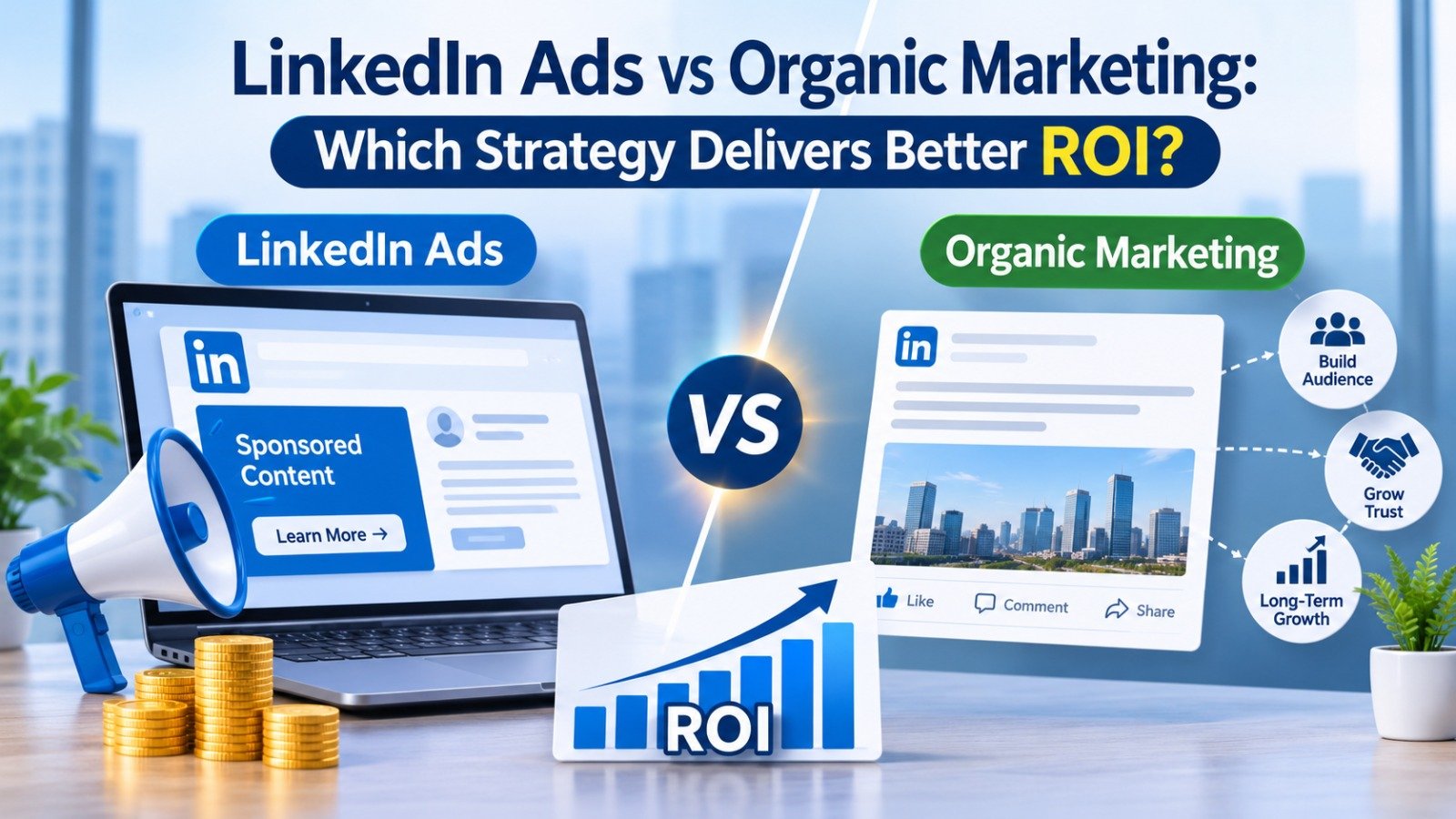
LinkedIn has become one of the most powerful platforms for B2B marketing, professional networking, and business growth. Companies use it to connect with decision-makers, generate qualified leads, build brand awareness, and establish industry authority. However, businesses often face an important question: should they invest in LinkedIn Ads or focus on organic marketing?
Both strategies offer unique advantages. LinkedIn Ads provide targeted reach and faster visibility, while organic marketing helps businesses build trust, credibility, and long-term engagement. Understanding the differences between LinkedIn Ads vs Organic Marketing can help businesses choose the right approach and maximize their marketing return on investment (ROI).
In this blog, we will compare both strategies, explore their benefits and limitations, and explain which approach delivers better ROI for different business goals.
What Is LinkedIn Advertising?
LinkedIn advertising is a paid marketing strategy that allows businesses to promote their content, products, services, and job opportunities to a specific professional audience.
Unlike traditional advertising platforms, LinkedIn offers advanced targeting options based on professional characteristics, including job titles, industries, company size, seniority, skills, and business locations.
Businesses can use LinkedIn Ads to reach decision-makers, generate leads, promote webinars, increase website traffic, and support account-based marketing campaigns.
Popular LinkedIn Ad formats include:
-
Sponsored Content: Promoted posts that appear directly in users' LinkedIn feeds.
-
Message Ads: Sponsored messages delivered through LinkedIn messaging.
-
Text Ads: Simple advertisements displayed on LinkedIn pages.
-
Dynamic Ads: Personalized advertisements designed to engage specific audiences.
-
Lead Generation Ads: Ads with pre-filled forms that help businesses collect prospect information.
LinkedIn advertising is particularly useful for B2B companies that want to reach a highly specific professional audience within a shorter period.
What Is Organic LinkedIn Marketing?
Organic LinkedIn marketing refers to promoting a business, brand, or professional identity without paying for advertisements. It focuses on creating valuable content, building professional relationships, participating in discussions, and developing an engaged audience.
Instead of purchasing visibility, businesses earn attention through consistent activity and meaningful interactions.
Common organic LinkedIn marketing activities include:
-
Publishing educational articles and industry insights.
-
Sharing company updates, achievements, and case studies.
-
Posting thought leadership content.
-
Engaging with comments and relevant industry discussions.
-
Building relationships with potential customers and business partners.
-
Encouraging employees to share company content.
-
Participating in relevant LinkedIn groups and professional communities.
Organic marketing is especially valuable for businesses that want to establish credibility, strengthen brand identity, and develop long-term relationships with their target audience.
LinkedIn Ads vs Organic Marketing: Key Differences
Although both approaches aim to increase visibility and generate business opportunities, they differ in cost, reach, audience engagement, and long-term value.
|
Comparison Factor |
LinkedIn Ads |
Organic Marketing |
|---|---|---|
|
Investment |
Requires an advertising budget |
No direct advertising cost |
|
Reach |
Paid and targeted exposure |
Depends on content distribution and engagement |
|
Speed |
Faster visibility |
Takes time to build momentum |
|
Targeting |
Advanced audience targeting |
Relies on audience development |
|
Lead Generation |
Can generate leads quickly |
Builds leads through trust and relationships |
|
Brand Awareness |
Faster campaign-based awareness |
Long-term brand recognition |
|
Sustainability |
Visibility generally stops when campaigns end |
Content and audience can provide ongoing value |
|
Best For |
Lead generation and targeted campaigns |
Trust, authority, and community building |
The right choice depends on business objectives, available resources, target audience, and marketing timelines.
1. Cost and Marketing Investment
Cost is one of the biggest differences between LinkedIn Ads and organic marketing.
LinkedIn Ads require businesses to allocate a budget for impressions, clicks, or campaign objectives. The platform provides targeting capabilities, but advertising costs can be relatively high compared with other social media platforms, particularly in competitive B2B industries.
Organic marketing does not require direct advertising expenditure. However, it still involves costs related to content creation, employee time, social media management, research, and marketing tools.
LinkedIn Ads: Businesses can invest in paid campaigns to reach a specific audience and generate measurable campaign results.
Organic Marketing: Businesses can build visibility without paying for each impression or click, although consistent content production requires time and resources.
For companies with limited marketing budgets, organic marketing can be a practical starting point. Businesses with dedicated marketing budgets may benefit from combining both approaches.
2. Audience Reach and Targeting
LinkedIn Ads offer advanced targeting features that allow businesses to reach professionals based on their roles, industries, skills, company size, and other characteristics.
For example, a software company selling CRM solutions can target sales managers, marketing directors, business owners, and decision-makers in specific industries.
Organic marketing works differently. Its reach depends on content relevance, audience engagement, professional networks, and LinkedIn's content distribution system.
A well-written post that addresses a relevant industry challenge can attract attention, generate discussions, and reach professionals beyond a company's immediate network.
Which performs better?
LinkedIn Ads generally offer greater control over audience targeting, while organic marketing can help businesses attract audiences through useful and engaging content.
3. Lead Generation and Conversion Rates
Lead generation is a major reason businesses invest in LinkedIn marketing.
LinkedIn Ads allow businesses to run targeted campaigns, promote landing pages, and use Lead Gen Forms to collect information from interested prospects.
This makes paid advertising useful for promoting:
-
B2B software and SaaS solutions.
-
Professional consulting services.
-
Business events and webinars.
-
Enterprise solutions.
-
High-value products and services.
Organic marketing generates leads through educational content, customer success stories, industry discussions, and relationship-building activities.
For example, a company regularly sharing practical insights about business automation may attract business owners who eventually become potential customers.
However, paid advertising does not automatically guarantee conversions. The quality of the offer, landing page experience, targeting, and follow-up process all influence results.
4. Brand Awareness and Professional Credibility
Brand awareness and credibility are essential for businesses operating in competitive markets.
LinkedIn Ads can introduce a company to thousands of relevant professionals through targeted campaigns. They are useful when launching a product, announcing a service, or promoting an important business initiative.
Organic marketing, on the other hand, allows businesses to demonstrate expertise over time.
Consistently sharing useful information, industry perspectives, customer experiences, and business insights can position a company as a credible voice in its industry.
While advertisements can introduce a brand, organic content helps audiences understand its expertise and personality.
For businesses focused on long-term brand development, organic marketing plays an important role.
5. Long-Term Results and Sustainability
One of the most important factors when evaluating ROI is how long marketing results continue to deliver value.
LinkedIn Ads generally provide visibility while campaigns are active and funded. Once the advertising budget is exhausted or the campaign ends, paid exposure usually decreases.
Organic marketing can create long-term value through an established professional network, relevant content, audience relationships, and brand recognition.
For example, an informative LinkedIn article may continue attracting views and engagement after its publication, depending on its relevance and distribution.
This makes organic marketing a valuable long-term investment, although it does not guarantee continuous traffic or engagement.
How to Measure ROI From LinkedIn Ads and Organic Marketing
To understand which strategy delivers better ROI, businesses must track the right performance indicators rather than focusing only on impressions and likes.
Here are the important metrics to monitor:
|
Metric |
LinkedIn Ads |
Organic Marketing |
|---|---|---|
|
Cost Per Click (CPC) |
Important |
Not directly applicable |
|
Cost Per Lead (CPL) |
Important |
Can include content and labour costs |
|
Click-Through Rate (CTR) |
Measures ad engagement |
Measures post engagement with links |
|
Engagement Rate |
Measures audience interaction |
Measures audience interaction |
|
Conversion Rate |
Measures campaign effectiveness |
Measures content-driven conversions |
|
Customer Acquisition Cost (CAC) |
Measures paid acquisition efficiency |
Measures total organic acquisition costs |
|
Revenue Generated |
Tracks campaign revenue |
Tracks revenue from organic channels |
Businesses can calculate marketing ROI using the following formula:
Example:
Suppose a business spends ₹50,000 on LinkedIn advertising and generates ₹1,50,000 in attributable revenue.
This means the campaign generated ₹2 in profit for every ₹1 invested, before accounting for any additional costs not included in the calculation.
The same approach can be applied to organic marketing by including content production, employee time, tools, and other relevant expenses.
When Should Businesses Choose LinkedIn Ads?
LinkedIn Ads are suitable when businesses need targeted exposure and want to achieve specific marketing objectives within a defined period.
Consider paid advertising when:
-
Launching a new product: Reach relevant professionals and introduce new offerings.
-
Generating B2B leads: Connect with potential customers and business decision-makers.
-
Promoting webinars: Increase registrations among relevant industry professionals.
-
Entering new markets: Reach professionals in specific industries or geographical locations.
-
Running time-sensitive campaigns: Generate visibility for events, announcements, or limited-period offers.
Businesses should have a clearly defined target audience, campaign objective, and conversion strategy before investing in paid advertisements.
When Should Businesses Choose Organic LinkedIn Marketing?
Organic marketing is a strong option for companies interested in developing a professional presence and building relationships over time.
It is particularly useful when:
-
Building brand authority: Share industry knowledge and establish expertise.
-
Developing professional relationships: Connect with customers, partners, and industry experts.
-
Growing a company page: Build an audience interested in the company's updates and services.
-
Establishing thought leadership: Share opinions, research, and practical business insights.
-
Supporting customer trust: Publish testimonials, case studies, and valuable educational content.
Organic marketing is particularly effective when businesses can consistently produce relevant and useful content.
Why Combining LinkedIn Ads and Organic Marketing Can Deliver Better ROI
Instead of choosing only one strategy, businesses can combine LinkedIn Ads and organic marketing to create a more balanced marketing approach.
Paid campaigns can help businesses reach new audiences, while organic content builds credibility and encourages long-term engagement.
For example, a B2B technology company can follow this approach:
-
Step 1: Publish educational posts about industry challenges and business solutions.
-
Step 2: Build an organic audience by consistently sharing valuable content.
-
Step 3: Use LinkedIn Ads to promote high-performing content to relevant decision-makers.
-
Step 4: Run Lead Gen campaigns to collect information from interested prospects.
-
Step 5: Use follow-up communication and relevant resources to nurture potential customers.
-
Step 6: Track leads, conversions, customer acquisition costs, and revenue.
This integrated approach helps businesses combine the targeting advantages of paid advertising with the credibility-building potential of organic marketing.
Common Mistakes Businesses Should Avoid
Regardless of which strategy they choose, businesses should avoid common mistakes that can reduce marketing performance.
1. Focusing only on impressions: High visibility does not necessarily translate into leads or revenue.
2. Ignoring audience targeting: Reaching the wrong professionals can increase advertising costs without generating meaningful business opportunities.
3. Publishing inconsistent content: Irregular posting makes it difficult to establish a recognizable brand presence.
4. Using promotional content excessively: Audiences are more likely to engage with useful information than repetitive sales messages.
5. Not tracking conversions: Without conversion tracking, businesses cannot accurately evaluate marketing effectiveness.
6. Ignoring follow-ups: Generating leads is only one part of the process. Businesses must also nurture prospects and maintain communication.
Final Verdict: LinkedIn Ads vs Organic Marketing – Which Delivers Better ROI?
There is no universal winner in the LinkedIn Ads vs Organic Marketing comparison. Both strategies can deliver strong ROI when aligned with the right business objectives.
LinkedIn Ads are generally more suitable for businesses seeking faster visibility, precise audience targeting, and campaign-based lead generation. Organic marketing is valuable for building professional credibility, developing relationships, and creating sustainable brand awareness.
For businesses looking to achieve both immediate and long-term results, combining the two strategies is often the most balanced approach.
The key is to measure performance based on qualified leads, customer acquisition costs, conversions, and actual revenue rather than simply counting impressions or engagement.
Ultimately, the best LinkedIn marketing strategy is not necessarily the one that generates the most attention, but the one that creates meaningful business growth.
Frequently Asked Questions (FAQs)
1. Are LinkedIn Ads better than organic marketing?
LinkedIn Ads are better for targeted reach and faster lead generation, while organic marketing is useful for building brand credibility and long-term relationships. The better option depends on business goals.
2. Is organic LinkedIn marketing free?
Organic LinkedIn marketing does not require advertising payments. However, businesses may still incur expenses for content creation, marketing tools, and employee resources.
3. Are LinkedIn Ads worth the investment for small businesses?
Yes, LinkedIn Ads can be valuable for small businesses targeting specific B2B audiences. However, businesses should start with clear campaign objectives and carefully monitor their cost per qualified lead.
4. How often should businesses post on LinkedIn?
Businesses should maintain a consistent posting schedule based on their content resources and audience engagement. Quality, relevance, and consistency are more important than publishing excessively.
5. Can LinkedIn organic marketing generate leads?
Yes. Educational posts, thought leadership articles, case studies, and professional networking can attract potential customers and generate qualified business inquiries.
6. What is the best way to improve LinkedIn marketing ROI?
Businesses should define their target audience, publish relevant content, optimize paid campaigns, monitor conversion metrics, and follow up with potential customers.