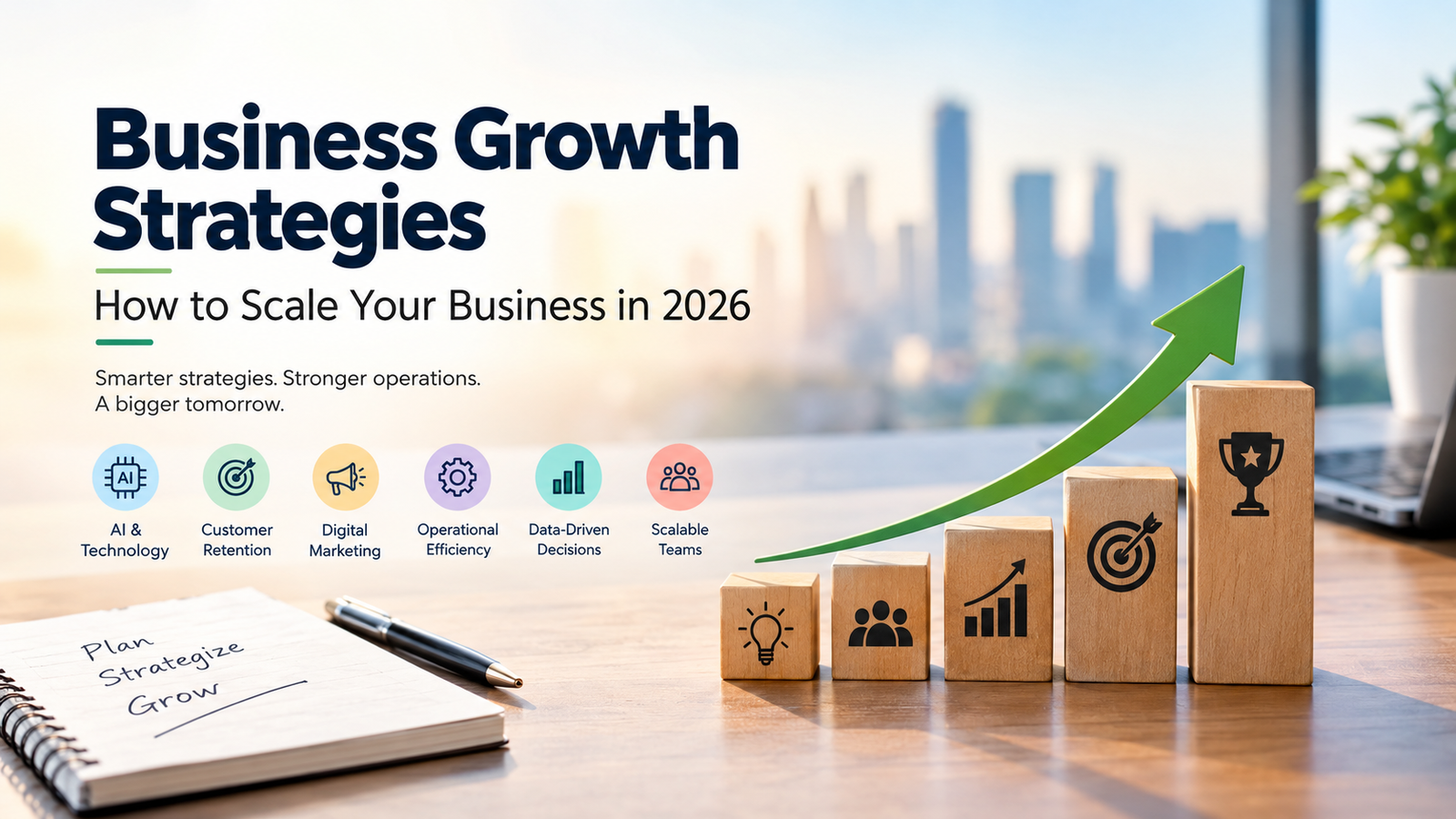
Business Growth Strategies are becoming increasingly important as companies operate in a competitive environment shaped by changing customer expectations, digital technology, artificial intelligence, and evolving market conditions. Growing a business is no longer simply about increasing sales. Sustainable growth requires businesses to improve customer relationships, strengthen operations, adopt useful technology, build a recognizable brand, and make informed decisions using reliable data.
For businesses in India, particularly MSMEs, the opportunity is significant. Government data published in 2026 states that MSMEs contribute around 31.1% of GDP, 35.4% of manufacturing output and 48.58% of exports, highlighting the importance of smaller businesses to the wider economy.
At the same time, digital transformation is becoming an increasingly important part of competitiveness. A 2026 Vi Business study reported that 57% of surveyed MSMEs viewed AI as important for business growth, while about 25% had already integrated AI into their workflows.
What Is Business Growth?
Business growth refers to the process of increasing the size, revenue, customer base, market presence, profitability, or operational capacity of a company.
Growth can happen in several ways:
- Increasing sales revenue
- Acquiring new customers
- Retaining existing customers
- Entering new markets
- Launching new products or services
- Increasing average customer value
- Improving operational efficiency
- Building new distribution channels
- Expanding a team or physical presence
- Using technology to improve productivity
However, rapid expansion without proper planning can create operational problems. Effective growth should therefore focus not only on how fast a company grows, but also on whether the business can manage that growth efficiently.
Why Business Growth Requires a Strategic Approach
Many businesses concentrate heavily on acquiring customers while overlooking other areas such as retention, profitability, technology, and internal processes.
For example, a company may generate more leads but lack a proper CRM system to manage them. Another company may increase orders but struggle with inventory management or customer support.
This is why modern business growth strategies need to connect marketing, sales, finance, technology, customer experience, and operations.
A strong growth strategy answers five important questions:
- Who is the target customer?
- What problem does the business solve?
- How can the company acquire customers efficiently?
- How can customers be retained?
- How can operations scale without reducing quality?
1. Build a Strong Digital Presence
One of the first steps toward business growth is establishing a strong digital presence.
Customers increasingly research businesses online before making purchasing decisions. A professional website, active social media presence, search engine optimization, online reviews, and useful content can help a company build credibility.
Businesses should focus on:
- A professional and mobile-friendly website
- Search engine optimization
- Google Business Profile where relevant
- Social media marketing
- Content marketing
- Email marketing
- Online reviews and reputation management
- Consistent branding
A digital presence should not simply promote products. It should answer customer questions, demonstrate expertise, communicate value, and create reasons for potential customers to trust the business.
2. Use AI to Improve Business Productivity
Artificial intelligence is becoming an important component of modern business growth strategies.
Businesses can use AI for repetitive and data-intensive tasks such as:
- Customer support
- Lead qualification
- Content creation
- Data analysis
- Email personalization
- Sales forecasting
- Customer segmentation
- Document processing
- Internal knowledge management
- Marketing automation
Government information published in 2026 notes that India's IndiaAI Mission has an approved outlay of ₹10,371.92 crore and includes initiatives intended to support AI adoption and productivity among MSMEs.
However, businesses should avoid adopting AI simply because it is a trend. The technology should solve a clearly identified business problem.
For example, instead of attempting to automate an entire department immediately, a company could start by automating repetitive customer inquiries or lead follow-ups and then measure the results.
The goal should be business value, not technology adoption for its own sake.
3. Strengthen Customer Retention
Acquiring a new customer is only one part of business growth. Retaining existing customers can create repeat purchases, referrals, and stronger long-term revenue.
Businesses can improve customer retention through:
- Personalized communication
- Loyalty programs
- Faster customer support
- Regular follow-ups
- Customer feedback systems
- Personalized recommendations
- After-sales service
- Consistent product quality
A CRM system can help businesses maintain customer information, track interactions, monitor leads, automate follow-ups, and identify opportunities for repeat sales.
Instead of viewing every customer interaction as a separate transaction, businesses should aim to develop long-term customer relationships.
4. Develop a Data-Driven Marketing Strategy
Marketing decisions based purely on assumptions can make growth expensive and unpredictable.
Businesses should track metrics such as:
- Website traffic
- Lead generation
- Conversion rate
- Customer acquisition cost
- Customer lifetime value
- Return on marketing investment
- Social media engagement
- Email open and conversion rates
- Sales by channel
This information can help businesses understand which marketing activities are producing meaningful results.
For example, if one marketing channel generates a large number of leads but very few conversions, while another produces fewer leads with higher conversion rates, the company can investigate the quality and economics of each channel before allocating more resources.
Data does not eliminate business judgment, but it can provide a stronger foundation for making decisions.
5. Focus on Customer Acquisition and Customer Value
A business needs a predictable system for acquiring customers.
A customer acquisition strategy can include:
Awareness → Interest → Consideration → Conversion → Retention → Referral
Businesses can create this journey using:
- SEO
- Social media
- Paid advertising
- Educational content
- Webinars
- Email campaigns
- Referral programs
- Partnerships
- Direct sales
- Influencer or creator collaborations
However, simply increasing the number of customers is not always enough.
Businesses should also look at customer lifetime value.
Increasing the value generated by existing customers can involve:
- Cross-selling
- Upselling
- Subscription models
- Bundled products
- Premium services
- Repeat-purchase programs
This creates additional opportunities for growth without relying entirely on acquiring new customers.
6. Expand Through New Markets
Market expansion is another important business growth strategy.
A company may expand geographically or target a new customer segment.
For example, a business serving only one city could explore nearby markets. A company selling primarily to consumers could potentially develop a business-to-business offering if its capabilities support it.
Before entering a new market, businesses should research:
- Customer demand
- Competitors
- Pricing
- Distribution
- Regulations
- Customer preferences
- Marketing costs
- Operational requirements
Expansion should be based on evidence rather than simply assuming that a successful product will perform equally well everywhere.
7. Improve Operational Efficiency
Growth can expose weaknesses in business processes.
When customer numbers increase, inefficient systems can create delays, errors, higher costs, and poor customer experiences.
Businesses should regularly review processes such as:
- Lead management
- Order processing
- Inventory management
- Customer support
- Employee communication
- Financial reporting
- Procurement
- Marketing workflows
- Sales follow-ups
Automation can be useful where tasks are repetitive and rules-based.
The objective is not to automate everything. Instead, businesses should identify bottlenecks and determine where technology can reduce unnecessary manual work.
8. Build a Scalable Team
A business cannot scale sustainably without people who can support its growth.
As the company expands, founders and managers may need to delegate responsibilities and introduce clearer processes.
Important areas include:
- Hiring the right talent
- Employee training
- Performance measurement
- Leadership development
- Internal communication
- Role clarity
- Knowledge documentation
Future-ready businesses also need employees who can work effectively with digital tools and AI.
KPMG's 2026 analysis of India's MSME sector highlights talent readiness, productivity, digital adoption, and AI-ready skills as important issues for businesses preparing for future growth.
9. Create a Strong Brand
A strong brand can differentiate a company when customers have multiple choices.
Brand building involves more than a logo. It includes:
- Positioning
- Brand voice
- Visual identity
- Customer experience
- Content
- Reputation
- Consistency
- Value proposition
Businesses should be able to communicate clearly:
Who are we?
Who do we serve?
What problem do we solve?
Why should customers consider us?
Consistent communication across websites, social media, advertising, packaging, and customer interactions can strengthen brand recognition.
10. Monitor Financial Performance
Revenue growth does not automatically mean business success.
A company can generate increasing sales while experiencing declining margins or cash-flow problems.
Businesses should therefore monitor:
- Revenue
- Gross margin
- Net profit
- Operating expenses
- Cash flow
- Accounts receivable
- Customer acquisition cost
- Return on investment
- Working capital
Financial visibility allows management to identify which products, customers, and channels are contributing to sustainable growth.
11. Strengthen Cybersecurity as the Business Scales
Digital growth also increases digital risk.
Businesses increasingly depend on websites, cloud applications, payment systems, customer databases, employee devices, and online communication.
A 2026 Tata Tele Business Services and CyberMedia Research study reported that 84% of surveyed Indian SMEs planned to increase cybersecurity investment over the following 12–24 months.
Businesses should therefore consider:
- Strong passwords and authentication
- Employee cybersecurity training
- Regular software updates
- Data backups
- Access controls
- Secure payment systems
- Customer-data protection
- Incident-response planning
Cybersecurity should be considered part of business continuity rather than only an IT issue.
12. Measure Business Growth With the Right KPIs
A growth strategy becomes more useful when its results can be measured.
Businesses can track KPIs such as:
| KPI | What It Measures |
|---|---|
| Revenue Growth Rate | Increase in revenue over time |
| Customer Acquisition Cost | Cost of acquiring customers |
| Conversion Rate | Percentage of prospects becoming customers |
| Customer Retention Rate | Ability to retain customers |
| Customer Lifetime Value | Long-term customer value |
| Gross Margin | Profitability after direct costs |
| Website Conversion Rate | Website effectiveness |
| Repeat Purchase Rate | Customer loyalty and repeat sales |
| Lead-to-Customer Rate | Sales effectiveness |
Businesses should avoid tracking dozens of metrics without a clear purpose. A smaller set of meaningful KPIs can provide a clearer picture of performance.
The Future of Business Growth
The next phase of business growth is likely to involve a combination of technology, customer experience, data, skilled people, and operational efficiency.
AI is moving from experimentation toward practical business applications. Deloitte's 2026 India findings reported significant AI deployment across areas including product development, strategy and operations, marketing and sales, and supply chain.
At the same time, businesses need to ensure that technology adoption is supported by reliable data, appropriate processes, security, and human oversight.
For smaller businesses, this does not necessarily mean making large technology investments immediately. A practical approach is to identify one business problem, test a solution, measure its impact, and then scale what works.
Final Thoughts
Business growth is not simply about getting bigger; it is about becoming stronger, more efficient, more customer-focused, and more capable of adapting to change. Businesses that combine a strong digital presence with customer retention, data-driven marketing, efficient operations, financial discipline, and appropriate technology can create a stronger foundation for sustainable expansion.
For Indian businesses, particularly MSMEs, digitalisation and AI are creating new opportunities to improve productivity and competitiveness. At the same time, successful growth still depends on fundamentals such as understanding customers, delivering consistent value, managing cash flow, developing employees, and measuring performance. Current government and industry initiatives show that digital adoption and technology are becoming increasingly relevant to the country's business ecosystem.
The most effective approach is therefore to treat growth as a continuous process: understand the market, acquire the right customers, retain them, improve operations, measure results, and scale proven strategies. This approach can help businesses build sustainable growth rather than relying on short-term increases in sales.