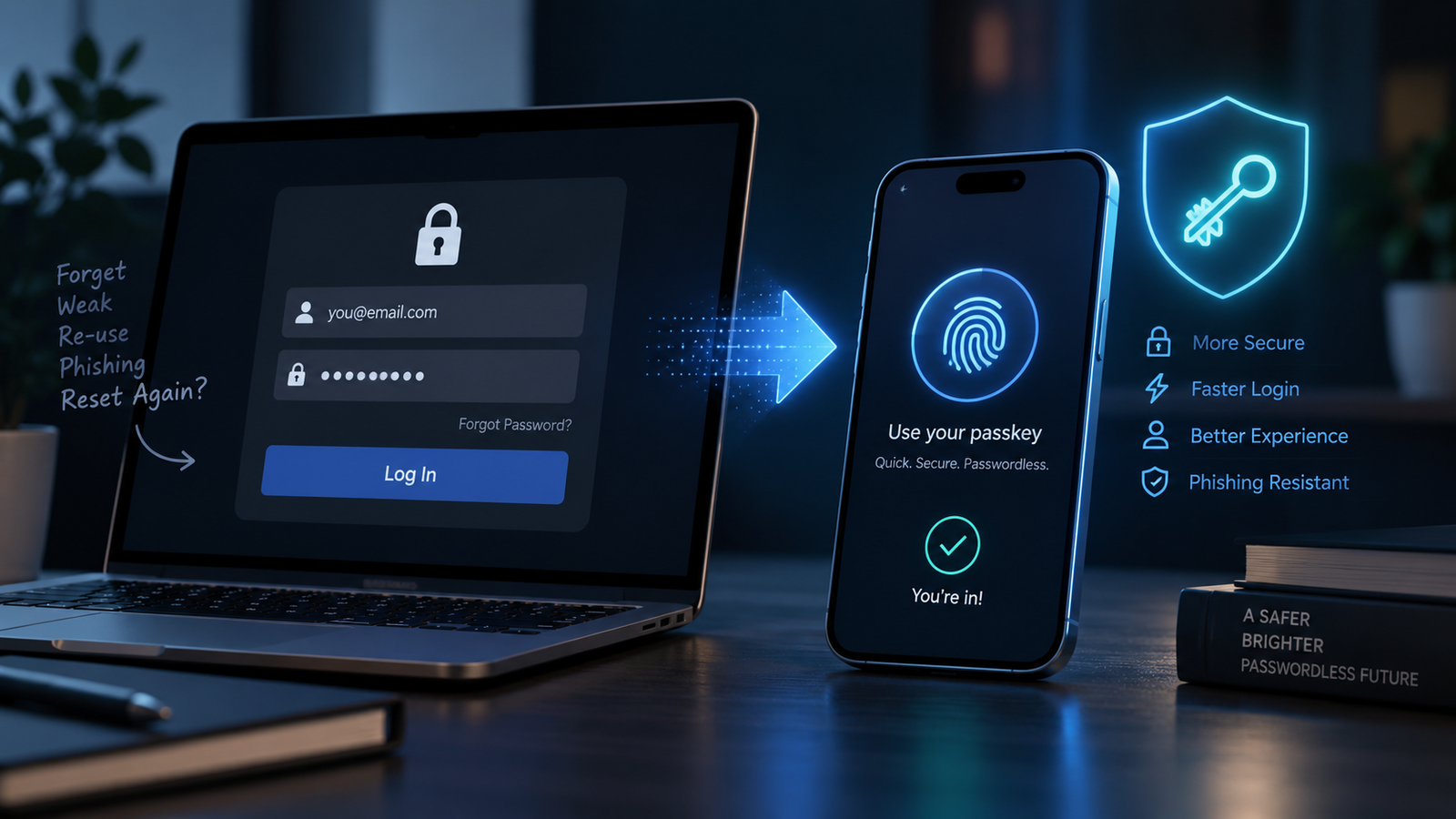
For decades, logging into a website has usually meant remembering a password. We have become so accustomed to typing passwords that it is easy to forget how much friction they create. People forget them, reuse them across different services, choose weak combinations, and regularly have to reset them. At the same time, passwords remain an attractive target for phishing and credential theft. Now, a different approach is becoming increasingly common: passkeys. Instead of asking users to remember and type a password, passkeys allow them to authenticate using the security features already built into their devices.
A passkey is a digital credential designed to let users sign in without entering a traditional password. Passkeys are built on public-key cryptography and the WebAuthn standard. During registration, a device creates a pair of cryptographic keys. The private key remains protected by the user's device or credential manager, while the corresponding public key is registered with the website. When the user later signs in, the website sends a challenge and the device uses the private key to produce a cryptographic response. The website can then verify that response using the public key. This means the website does not need to receive or store the user's private authentication secret.
For users, the experience can feel much simpler than a traditional login. Instead of typing an email address and password, a user may simply select a passkey and unlock it with a fingerprint, face recognition, PIN, or another device-based method. The biometric information itself is not being sent to the website as a password. Rather, the authenticator on the device verifies the user and allows the protected credential to be used. WebAuthn is designed so that authenticators require user consent before performing the relevant operation.
One of the biggest differences between passwords and passkeys is their relationship with phishing. A traditional password can potentially be entered into a convincing fake website and stolen. Passkeys are designed around cryptographic credentials that are scoped to the website or relying party for which they were created. Because the authentication process involves proving possession of the appropriate private key rather than sending a reusable password, passkeys can provide strong resistance to common phishing-based credential theft. WebAuthn Level 3 specifically describes passkey authentication as phishing-resistant authentication.
The technology is no longer just an experimental idea. On August 25, 2026, the World Wide Web Consortium, or W3C, published Web Authentication Level 3 as an official Recommendation. The specification defines the web APIs and authentication mechanisms used for public-key credentials, including the technology that supports passkeys. Reaching Recommendation status means the standard has gone through the W3C process and provides a stable reference for web developers and other organizations working with WebAuthn.
Passkeys are also seeing significant adoption. According to the FIDO Alliance's 2026 State of Passkeys report, an estimated five billion passkeys are now in active use worldwide. Its survey of 11,000 consumers across ten countries, including India, found that 90% were familiar with passkeys and 75% had enabled a passkey on at least one account. The same research found that 68% of surveyed organizations with 500 or more employees were deploying, piloting, or rolling out passkeys for employee authentication.
Another important development is that passkeys are becoming more practical for everyday web applications. WebAuthn Level 3 includes capabilities intended to improve how passkeys work across devices and credential managers. Features such as conditional mediation can support passkey autofill experiences, while other additions help websites understand credential states and manage passkeys more effectively. These improvements are aimed at making passwordless authentication easier to integrate and operate at scale.
However, moving beyond passwords does not mean that authentication becomes completely effortless for businesses. A website adopting passkeys still needs to think carefully about account recovery, device changes, lost devices, multiple-device access, and situations where a user cannot access their usual authenticator. Developers also need to consider how passkeys fit alongside existing login methods during a transition period. WebAuthn documentation specifically identifies web application developers and those responsible for login and account recovery flows as important audiences for the standard.
For businesses, this makes passkeys more than just a new login button. Authentication is part of the overall customer experience. A complicated login process can create frustration, while a secure and convenient authentication method can reduce unnecessary friction. At the same time, businesses need to protect customer accounts and the information associated with them. Passkeys offer a way to approach both sides of the problem by combining device-based user verification with public-key cryptography.
The shift toward passkeys also represents a change in the way we think about passwords. For years, improving account security often meant creating longer passwords, adding password rules, and requiring additional verification codes. Those measures can still have a role, but passkeys approach the problem differently. Instead of asking people to create and remember increasingly complicated secrets, the authentication process can rely more heavily on cryptographic credentials managed by devices and credential managers.
This does not mean that passwords will disappear overnight. Billions of existing accounts still depend on them, and organizations have different technical requirements and migration challenges. Some users may also need recovery options or alternative authentication methods. The transition will therefore likely happen gradually, with websites supporting passkeys alongside existing authentication methods before eventually deciding how much they want to reduce their dependence on passwords.
The broader significance of passkeys is that logging into a website could eventually become less about remembering something and more about proving that you have access to a trusted authenticator. Your phone, computer, security key, or credential manager can handle much of the cryptographic work in the background, while the user simply verifies their identity through a familiar device interaction.
The password has been one of the fundamental building blocks of the internet for decades, but the way we authenticate is changing. With passkeys becoming widely deployed and WebAuthn continuing to mature as a web standard, passwordless authentication is moving from an emerging concept toward a practical part of modern web development. The future of logging in may not require users to remember a better password. It may require them to remember no password at all.